

The joint at the top of a window or sliding door frame is easy to miss from the ground, but it is often the one that fails first. Water runs down the wall and collects against the head of the frame. Dirt and mould build up in the sealant, and eventually the joint opens up and water gets behind the frame.
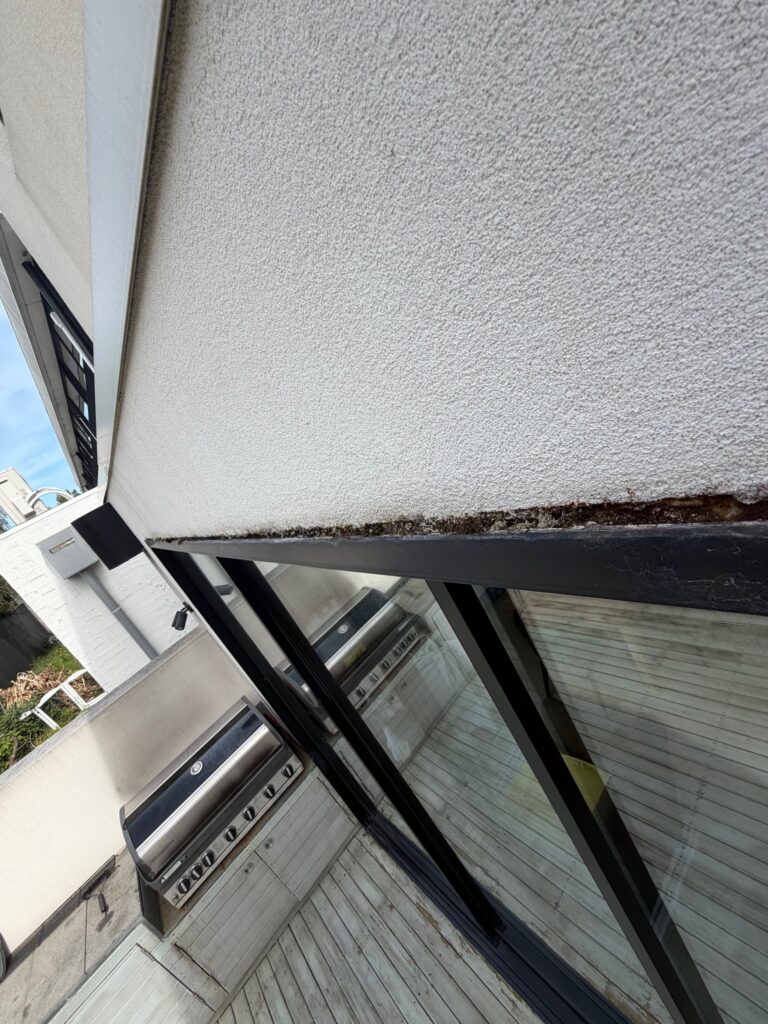
This Brighton home has large black framed aluminium sliding doors that open onto a timber deck with an outdoor kitchen, all set into a textured rendered wall. The frames and glass were in good condition. The sealant along the head of the frame was not: it had broken down, filled with dirt and organic growth, and pulled away from the render in places. Here is what we resealed and why this joint needs more care than any other on an external window.
Quick answer: Window caulking means cutting out the old, failed sealant where the frame meets the wall, cleaning and drying the joint, then running a new bead of flexible, UV stable silicone between the frame and the render. The head joint matters most because water sheds down the wall onto it. Sealing over old sealant only hides the gap for a season.
Project at a Glance
| Detail | This project |
|---|---|
| Location | Brighton, Bayside, south east Melbourne |
| Property type | Residential home, existing windows and sliding doors |
| Scope | Removal of failed sealant and recaulking of the external frame to render joints on rear sliding doors and windows |
| Key substrates | Black powder coated aluminium frames, textured acrylic render |
| Areas | External head and jamb joints facing the rear deck and backyard |
| Products | UV stable neutral cure silicone in black, colour matched to the frames |
What We Resealed
The scope covered the joints where the rear openings meet the rendered wall:
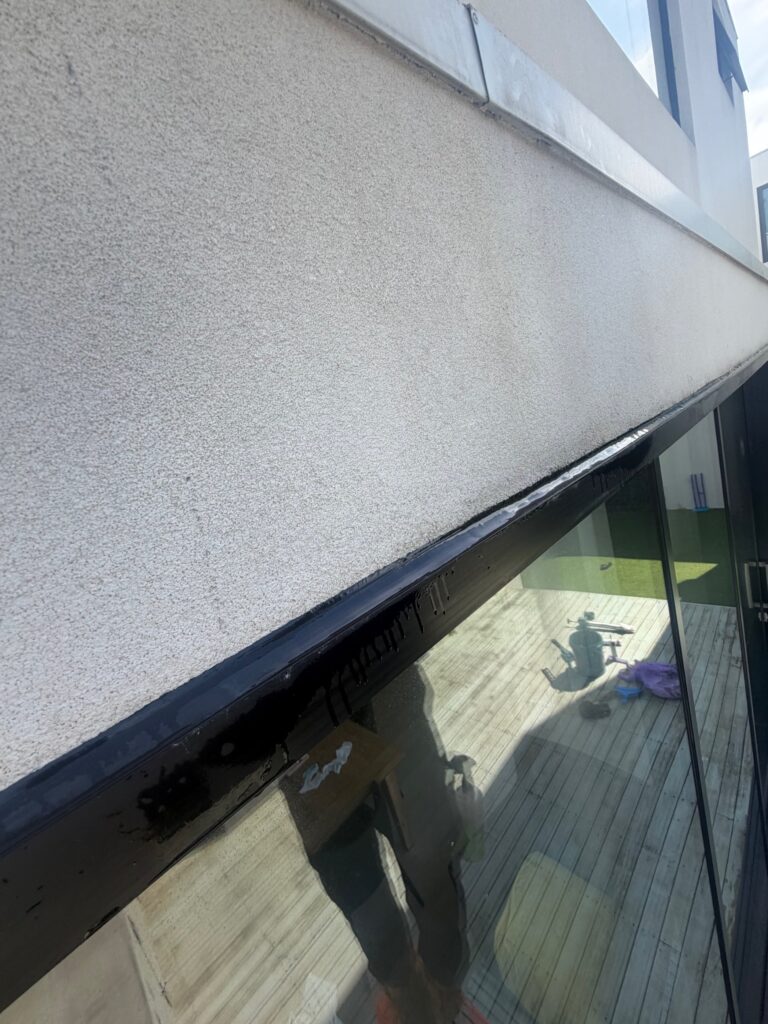
- Head joint. The full length of the joint along the top of the frame. Water running down the render lands here first, which is why the old sealant had broken down and collected dirt and growth.
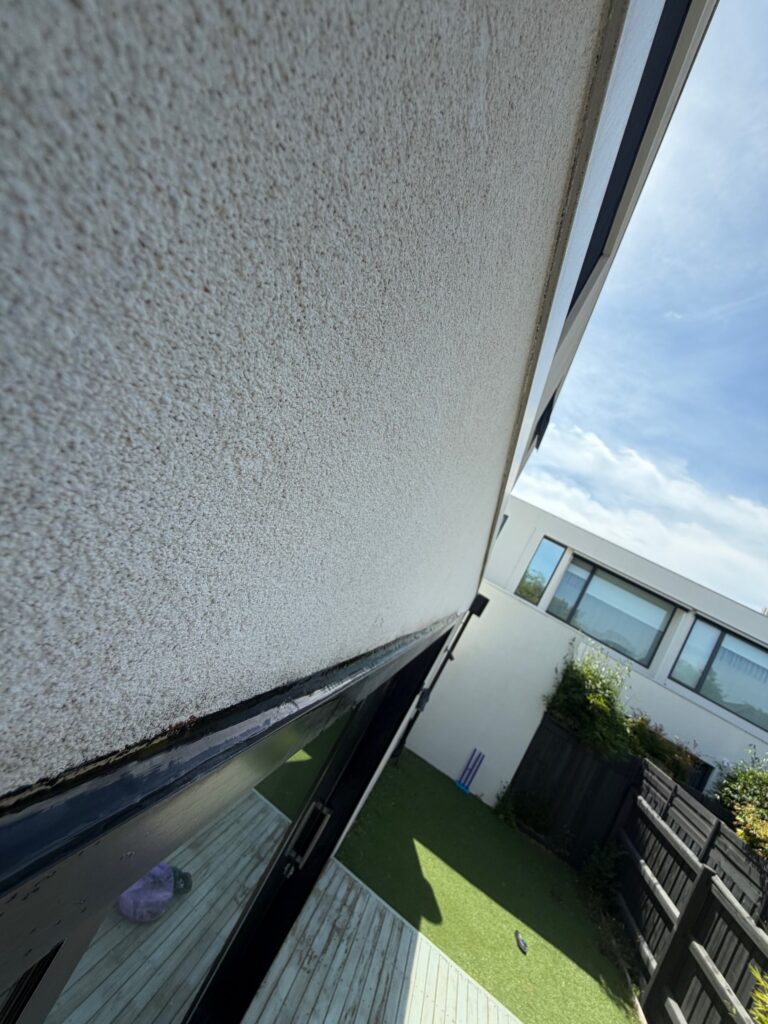
- Jamb joints. The vertical joints at each side of the frame, where the aluminium meets the render return.
- Frame corners. Where the head meets the jambs. Corners are where a bead most often splits, because the frame moves in two directions there.
Why External Window Caulking in Brighton Is a Different Job
Bayside homes are harder on window sealant than most of Melbourne. Our guide on why caulking windows matters covers the basics. Here is what changes near the water and on a job like this one:
- The old sealant has to come out completely. New silicone does not bond to old sealant, dirt or mould. Everything in the joint is cut and scraped back to clean frame and render.
- Textured render is hard to seal against. A coarse render finish leaves an uneven edge, so the joint is cleaned back carefully and the bead is tooled so it bonds into the texture without smearing across the wall.
- Salt air and sun. Salt and UV break down cheaper sealants quickly. A UV stable neutral cure silicone made for external use holds up far longer.
- Aluminium moves. Long aluminium frames expand and contract with the heat, so the bead needs enough depth and flexibility to move with the frame without tearing.
- Black frames show everything. A wobbly or patchy bead stands out against a black frame and pale render. The silicone is colour matched to the frame and tooled to a straight, even line.
Products and Method
- All failed sealant, dirt and organic growth cut out and removed back to clean frame and render
- Joints cleaned and left to dry before sealing
- Backing rod installed where the gap was deep, so the bead sits at the right depth to flex
- UV stable neutral cure silicone in black, colour matched to the powder coated frames
- Beads tooled to a neat concave profile so water sheds off the frame instead of sitting in the joint
Window Caulking FAQs
How do I know my windows need recaulking?
Look for sealant that is cracked, hard, shrinking or pulling away from the frame, dark lines of dirt or mould along the joint, and gaps between the frame and the wall. Water stains or peeling paint around the frame inside are also warning signs.
Can you caulk over the old window sealant?
No. New silicone does not bond properly to old sealant, and any dirt or mould underneath stays there. The old bead has to come out completely, and the joint has to be cleaned and dried, before new sealant goes in.
How long does it take to recaulk windows and sliding doors?
A set of rear sliding doors and windows like these is usually done within a day. Most of the time goes into removing the old sealant and preparing the joints, not applying the new bead.
Will window caulking stop a leak?
It stops water getting in around the frame, which is the most common cause. If water is coming through the frame itself, a failed sill flashing or the wall, sealant alone will not fix it. Our guide to window leak repair in Melbourne explains how to tell the difference.
Window Caulking Across Brighton and Bayside
Professional Caulking Group handles window caulking, sliding doors, bathrooms, kitchens and external joints for homeowners, renovators and property managers across Melbourne, including Brighton, Brighton East, Hampton, Sandringham, Elsternwick and Bentleigh. See our service areas.
Over seven years sealing Melbourne homes, with more than 600 five star Google reviews.
Call 0435 803 646 or request a quote for your project.