

Staircase caulking is rarely the first thing on a home improvement list, but it is one of the details that changes how finished a house feels. A staircase is the piece of joinery everyone looks at, and when oak, white paint and glass all meet in one place, every junction is a visible line.
This home in Ivanhoe was already built and lived in. The owners are working through a round of improvements, and sharpening up the lines around the staircase and the void above it was part of that. Here is what the job covered and why each junction needed a different approach.
Quick answer: Staircase caulking seals the junctions where stair treads and risers meet the stringers, where stringers meet the wall, and where a glass balustrade sits in its channel. In an established home, any old or cracked sealant is removed first, then each joint is resealed with a flexible, colour matched product so the line stays closed and disappears.
Project at a Glance
| Detail | This project |
|---|---|
| Location | Ivanhoe, north east Melbourne |
| Property type | Established residential home, owner improvements |
| Scope | Staircase caulking, glass balustrade base, timber slat wall and stair void |
| Key substrates | Oak stair treads, risers and flooring, white painted stringers and plaster, frameless glass balustrade, timber slat wall panelling |
| Wet areas | None on this job |
| Products | Flexible colour matched sealant on timber junctions, paintable gap filler on painted joints, clear neutral cure silicone at the glass |
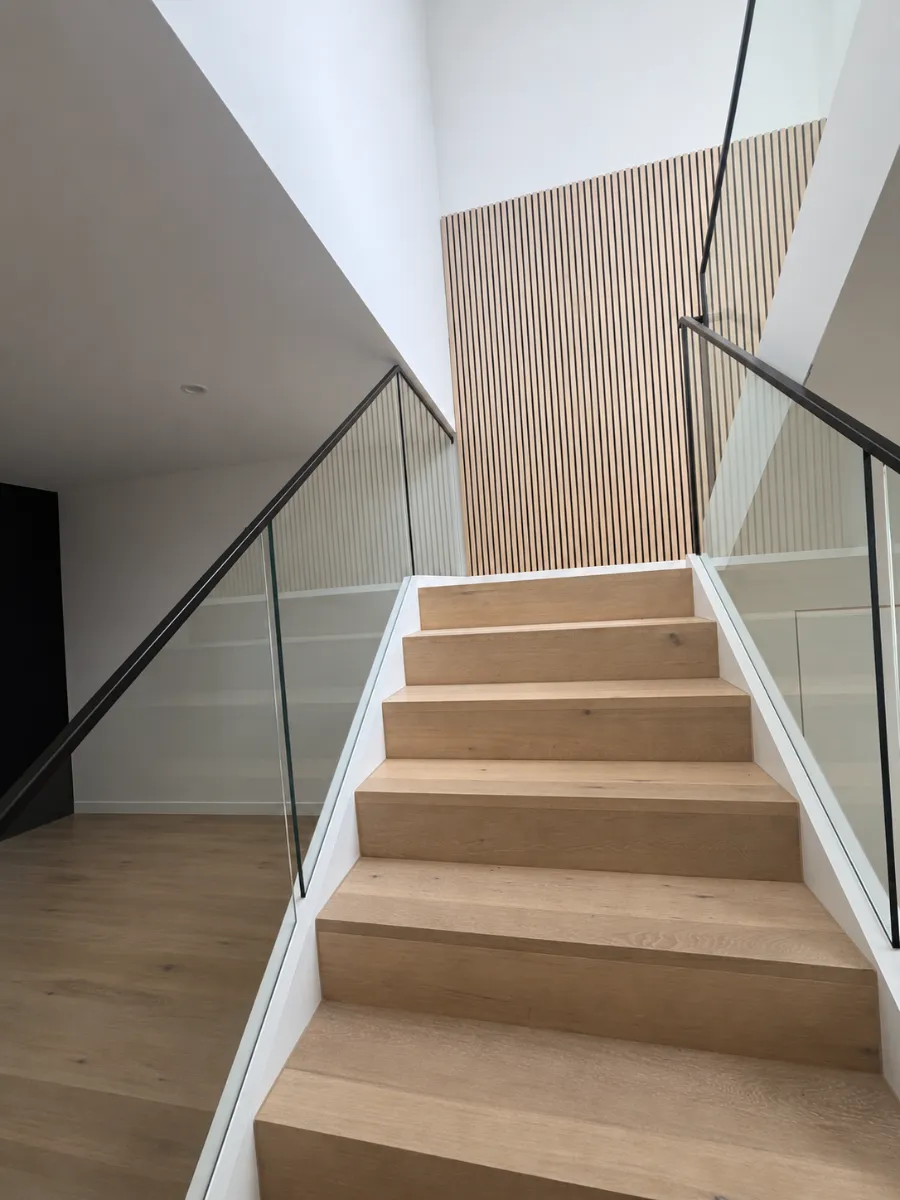
What We Sealed
The staircase caulking on this job covered every junction between the oak, the white paintwork and the glass:
- Tread and riser to stringer. Both ends of every oak step where it meets the white stringer, up the full flight.
- Stringer to wall. The edges of the stringers where painted timber meets plaster.
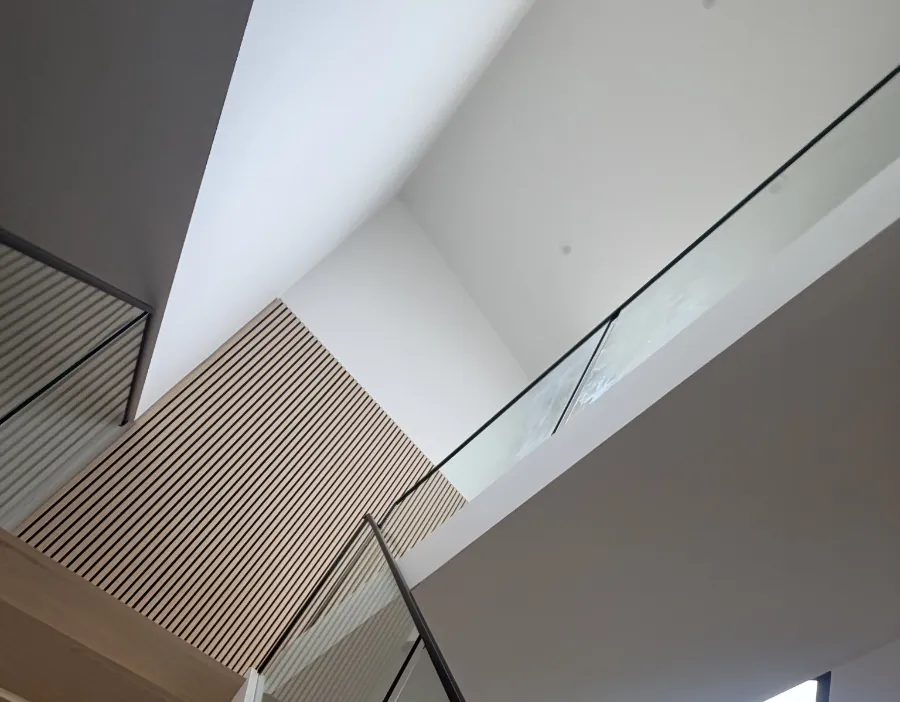
- Glass balustrade base. Along the line where each frameless glass panel enters its channel in the stringer and the landing edge.
- Timber slat wall. The perimeter of the slat panelling where it meets the plaster walls and the top of the stair.
- Void and landing edges. The plaster junctions through the double height void and under the upper landing.
- Skirting to floor. Where the white skirting meets the oak flooring at the base of the stair.
Where Glass Meets Paint
A frameless glass balustrade has nowhere to hide a rough edge. The glass drops into a narrow channel, and the line along that channel sits at eye level as you walk up the stair.
- The bead has to be fine. Glass shows the back of the sealant as well as the front, so a heavy bead is visible from both sides.
- It has to stay flexible. Glass panels move slightly when the handrail is leaned on. A neutral cure silicone moves with the panel instead of cracking away from it.
- It keeps the channel clean. An open channel collects dust that is almost impossible to get out. A sealed one wipes clean.
Oak Against White
Warm oak against white paint is a high contrast pairing. Any open joint reads as a dark line, and any heavy bead reads as a white smear on the timber. The approach is the same one we use for timber floor caulking:
- Consistent width. The same junction repeats on every step, so each line is tooled to the same fine width.
- Colour matched to the side it sits on. White against the stringer, so the bead reads as part of the paintwork and not as a stripe on the oak.
- Flexible, not rigid. Treads flex underfoot and timber moves with changes in moisture through the year. A flexible sealant stretches and recovers where a hard filler splits.
Staircase Caulking in a Lived-In Home
Working in an occupied home is different from a building site. There is furniture, flooring and a household to work around, so the method matters as much as the product.
- Old sealant comes out first. New sealant over a cracked or dirty bead does not bond. Failed sections are cut out and the joint cleaned back.
- Surfaces are protected. Oak and glass are masked where needed so the finished surfaces stay clean.
- The stair stays in use. The work is staged so the household can keep moving through the house.
Staircase Caulking Products and Method
- All joints vacuumed and wiped free of dust so the sealant bonds to the surface, not the dust.
- Flexible, colour matched sealant on every timber to paint junction on the staircase.
- Paintable gap filler on paint to paint joints such as stringer to wall and slat wall to plaster.
- Clear neutral cure silicone along the base of the glass balustrade.
- Every bead tooled to a consistent fine width, with the oak and glass masked where needed.
Staircase Caulking FAQs
Can you caulk a staircase in a home that is already lived in?
Yes. Most of our staircase caulking is done in finished, occupied homes. Any old or cracked sealant is cut out, the joints are cleaned, and the timber and glass are masked where needed so nothing marks the finished surfaces. The stairs stay in use while we work around the household.
How do you seal the base of a glass balustrade?
With a clear or colour matched neutral cure silicone, run along the line where the glass enters its channel. Neutral cure silicone bonds to glass and painted surfaces without staining and stays flexible, so the bead keeps dust out of the channel and does not crack when the panel moves slightly.
What sealant is used where oak stairs meet white paint?
A flexible, colour matched sealant. Timber moves with the seasons and stairs flex underfoot, so a rigid filler cracks and pulls away. On paint to paint joints, such as stringer to wall, we use a paintable gap filler so the line can be painted over and disappear.
How long does staircase caulking take to dry?
Most sealants skin over within an hour and the stairs can be used straight away. Full cure usually takes 24 hours or more depending on the product, the bead size and the weather, so avoid wiping or cleaning along the joints for the first day.
Staircase Caulking Ivanhoe and the North East
Professional Caulking Group handles staircase, skirting and timber floor caulking for established homes, renovations and new builds across Ivanhoe, Ivanhoe East, Eaglemont, Heidelberg and Rosanna, along with bathrooms, kitchens, laundries and external work. See the full list of service areas.
Over seven years sealing Melbourne homes, with more than 590 five star Google reviews.
Call 0435 803 646 or request a quote for your project.