

Timber floor caulking is the detail that makes new hardwood look built in rather than just installed. Timber and paint meet at dozens of junctions through a home, and every one of them is a visible line. On a staircase with white risers and stringers, a gap of a millimetre reads as a dark shadow from across the room.
This home in Brighton had been renovated with a new hardwood staircase and hardwood flooring running through to the laundry. The carpentry, floor finishing and painting were complete, and we came through last to seal the stairs and the laundry. Here is what the job covered and why each area needed a different approach.
Quick answer: Timber floor caulking seals the junctions where hardwood meets painted or fixed surfaces: stair treads to risers and stringers, flooring to joinery and kickboards, and skirting to wall. Because timber moves with the seasons, the joints need a flexible, colour matched sealant rather than a rigid filler, applied in a fine bead so the line disappears.
Project at a Glance
| Detail | This project |
|---|---|
| Location | Brighton, Bayside Melbourne |
| Property type | Residential home, renovation |
| Scope | Staircase and timber floor caulking, plus laundry joinery and benchtop |
| Key substrates | Hardwood stair treads and flooring, painted timber risers, stringers and wall panelling, 2 pac laundry joinery, stone benchtop |
| Wet areas | Laundry benchtop, sink and splashback |
| Products | Flexible colour matched sealant on timber junctions, paintable gap filler on painted joints, mould resistant neutral cure silicone at the laundry bench |
What We Sealed
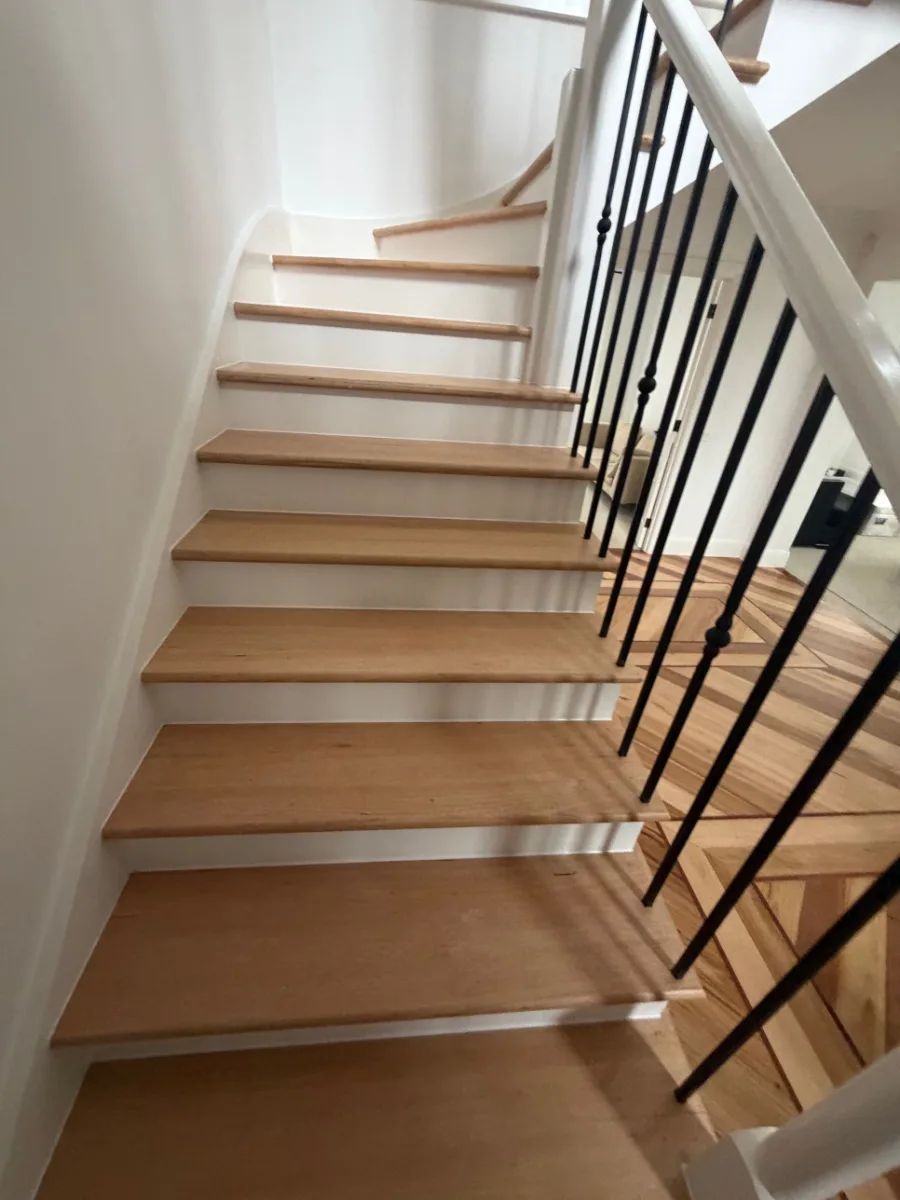
The staircase and timber floor caulking on this job covered every junction between the hardwood and the white paintwork:
- Tread to riser. The back edge of every hardwood tread where it meets the painted riser above it, across the full width of the stair.
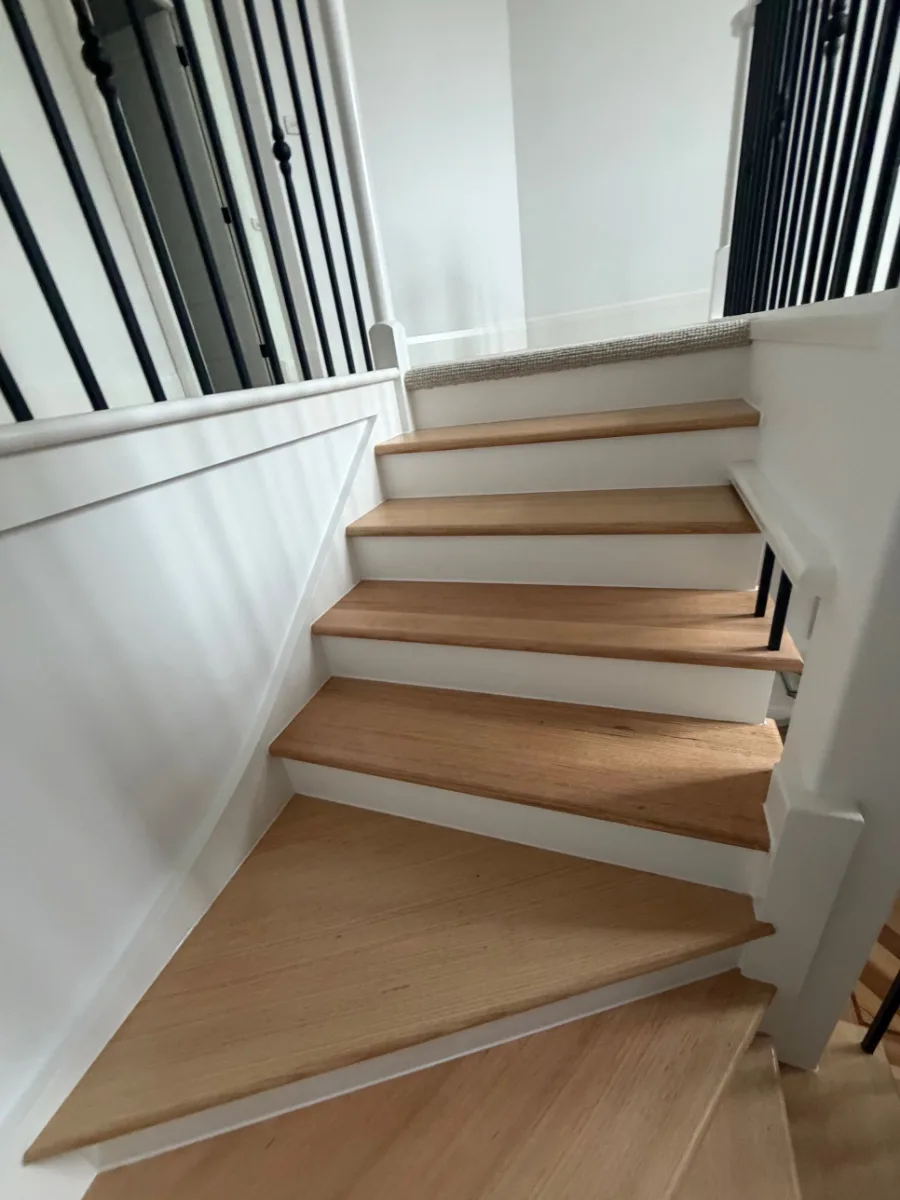
- Tread and riser to stringer. Both ends of each step where it houses into the wall stringer, including the angled winder treads at the turn.
- Stringer and panelling to wall. The top edge of the stringer and the wall panelling where they meet the plaster.
- Newel posts and landing. Around the base of the posts and along the landing edge where timber meets paint.
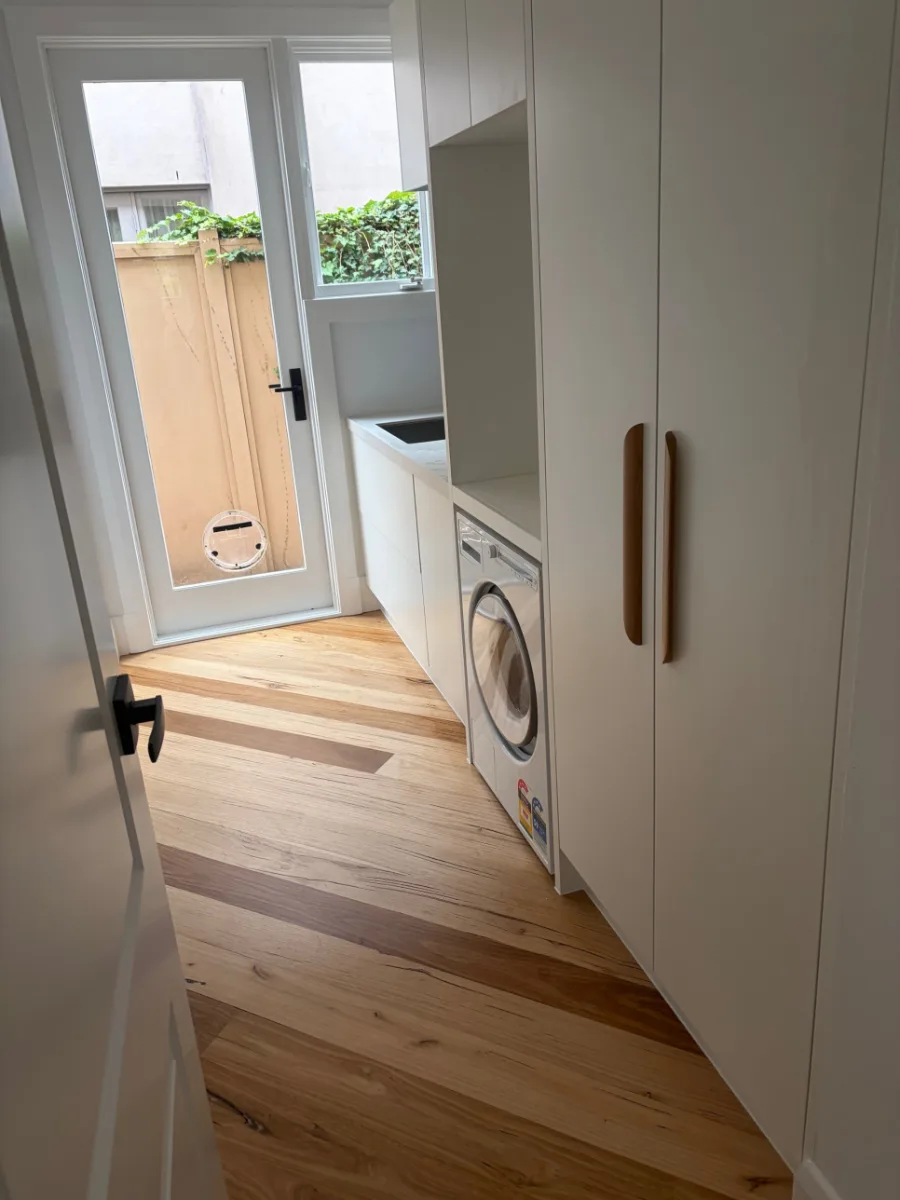
- Laundry joinery to floor. Kickboards and the tall cabinetry sealed to the timber floor so dust and water cannot get underneath.
- Laundry benchtop and sink. Benchtop to wall and around the undermount sink.
Why Staircases Show Every Gap
A staircase is the most looked at piece of joinery in a house. You walk towards it, up it and past it every day, and the light from a stairwell window runs straight along the joints.
- High contrast. Warm hardwood against white paint is unforgiving. Any open joint shows as a dark line, and any heavy bead shows as a white smear on the timber.
- Repetition. The same junction repeats on every step. If one bead is wider than the next, the eye picks it up immediately, so each line has to be tooled to the same width.
- Winders are cut by hand. The triangular treads at the turn meet the stringer at changing angles. These are the joints most likely to open up, and the ones that need the most care.
- Stairs flex. Treads move slightly underfoot. A rigid filler cracks within months. A flexible sealant moves with the stair and stays closed.
Timber Floor Caulking in the Laundry
In the laundry the hardwood floor runs under white joinery, a washing machine bay and out to an external door. This is where timber floor caulking does practical work as well as visual work.
- Keeping water off the board edges. A laundry is a wet area. The waterproofing requirements for wet areas deal with what sits under the floor, but the visible seal at the kickboards and bench is what stops everyday drips and spills from tracking under the cabinetry.
- Allowing for movement. Hardwood boards expand and shrink across their width through the year. The bead between floor and joinery has to stretch and recover, so we use a flexible sealant and keep the joint fine.
- Matching the surface it sits on. Against white joinery the bead is white. Where the line sits on the timber side, it is matched to the board tone so it does not read as a stripe.
Timber Floor Caulking Products and Method
- Timber floor caulking carried out as the final trade, after the floor coating and painting had cured.
- All joints vacuumed and wiped free of sanding dust so the sealant bonds to the surface, not the dust.
- Flexible, colour matched sealant on every timber to paint junction on the staircase.
- Paintable gap filler on paint to paint joints such as stringer to wall and panelling to plaster.
- Mould resistant, neutral cure silicone at the laundry benchtop, sink and splashback.
- Every bead tooled to a consistent fine width, with treads and floor masked where needed to keep the timber clean.
Timber Floor Caulking FAQs
Do timber stairs need caulking?
Yes, wherever the timber meets a painted surface. Treads, risers and stringers are cut and fitted by hand, so small gaps at the junctions are normal. Left open, they show as dark lines against white paint and collect dust. A fine bead of flexible sealant closes them and gives the staircase a finished, built-in look.
What sealant is used for timber floor caulking?
A flexible sealant that can move with the boards. Timber expands and shrinks through the year, so a rigid filler cracks and pulls away within a season. We use a flexible, colour matched sealant where timber meets painted surfaces and a paintable gap filler on paint to paint joints such as stringer to wall.
Will the caulking crack when the timber moves?
Not if the right product is used and the joint is sized properly. Seasonal movement in a hardwood floor is expected. A flexible sealant applied to a clean, dry joint stretches and recovers with the timber, where hard fillers and cheap acrylics split along the line.
When should caulking be done after a new timber floor or staircase goes in?
At the end of the job, once the floor has been sanded and coated and the painting is complete. The coatings need to be cured and the surfaces clean and dust free so the sealant bonds properly. Caulking is the last trade through before handover.
Staircase and Timber Floor Caulking Across Brighton and Bayside
Professional Caulking Group handles staircase, skirting and timber floor caulking for renovations and new builds across Brighton, Brighton East, Hampton, Sandringham and the wider Bayside area, along with bathrooms, kitchens, laundries and external work. See the full list of service areas.
Over seven years sealing Melbourne homes, with more than 590 five star Google reviews.
Call 0435 803 646 or request a quote for your project.