

Most caulking jobs are straight lines. This one was not.
Professional Caulking Group was recently booked for complete house caulking in Balwyn North, on an architectural new build in Melbourne’s inner east. The home runs curved plaster walls into dark timber floors, mitred stone across the kitchen and vanity, polished render instead of painted plasterboard, and full-height black-framed glazing front and back. Every one of those details removes something a caulker normally relies on: a straight edge, a forgiving surface, or a skirting line to hide behind.
In this project roundup we walk through what we sealed, the 7 details that make an architectural build harder to caulk than a standard home, and the 5 signs your own build needs a specialist rather than a general trade.
Quick answer: A complete house caulking project covers bathroom and wet area silicone, kitchen and joinery joints, internal floor perimeters, and window and external sealing. On an architectural build like this Balwyn North home, the work is driven by the substrates rather than the room: natural stone, Venetian plaster, timber veneer and powder-coated aluminium each need a different sealant and a different preparation method. Getting that wrong shows permanently.
Project at a Glance
| Detail | This project |
|---|---|
| Suburb | Balwyn North, Melbourne |
| Property type | Architectural new build, two storey |
| Areas sealed | Ensuite, bathrooms, kitchen, floor perimeters, windows, external cladding junctions |
| Key substrates | Veined marble, honed stone floor tiles, Venetian plaster, timber veneer joinery, dark timber flooring, powder-coated aluminium, glass |
| Hardest detail | Floor perimeter caulking around a curved stair wall |
| Sealant types | Neutral cure silicone for stone and glazing, sanitary grade for wet areas, exterior grade for cladding junctions |
This is not a bathroom reseal. If that is what you are after, our shower resealing cost guide covers pricing for single showers, baths and full bathrooms.
For a very different kind of job, see how we approached four identical townhouses in Carlton, where the challenge was consistency at volume rather than one-off detail.
7 Things That Make an Architectural Build Harder to Caulk
A volume builder home gives you square rooms, painted plasterboard and skirting boards. An architectural home gives you none of that. Here is what changed the approach on this Balwyn North project.
1. Curved walls cannot be tooled in one pass
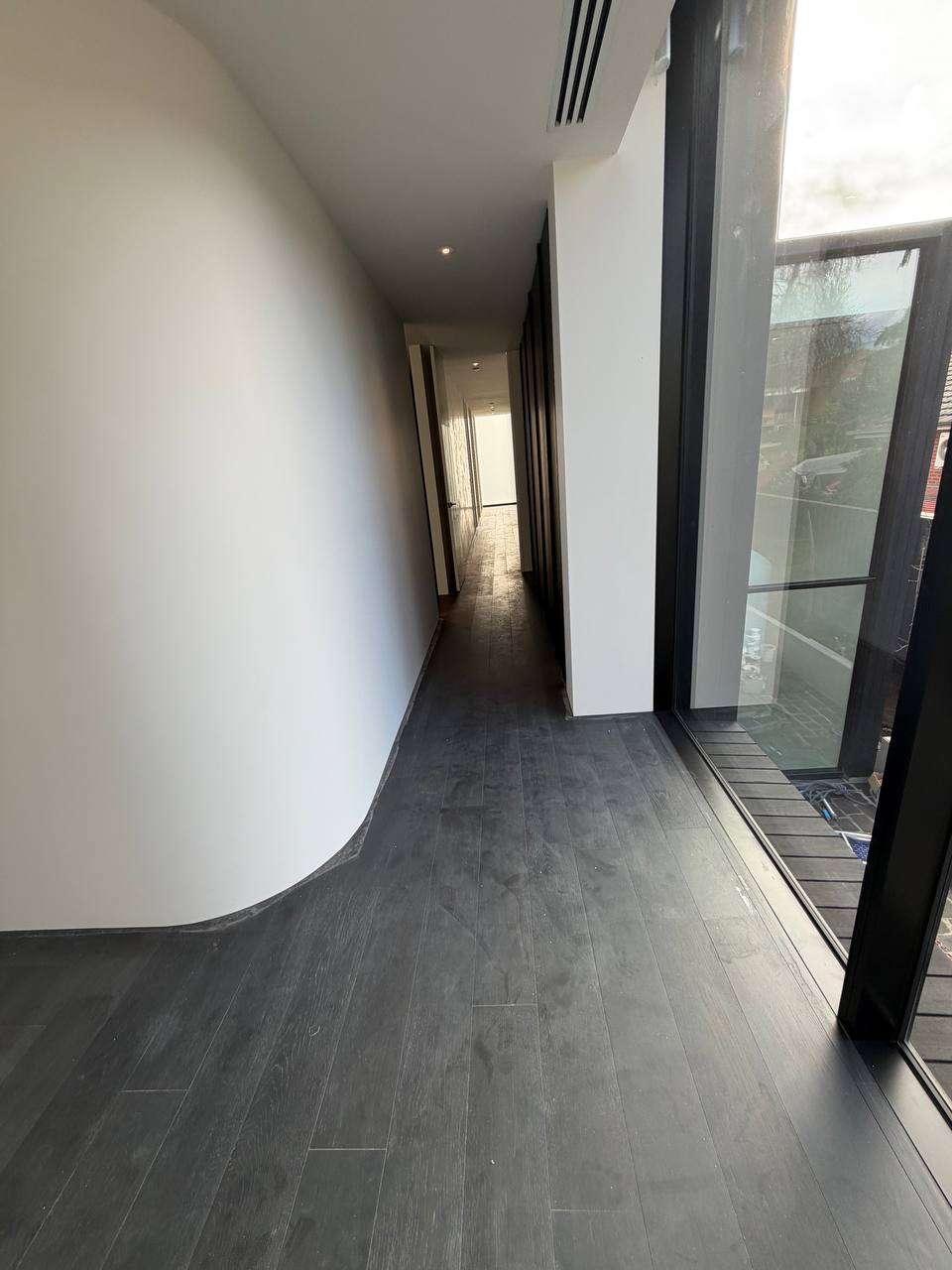
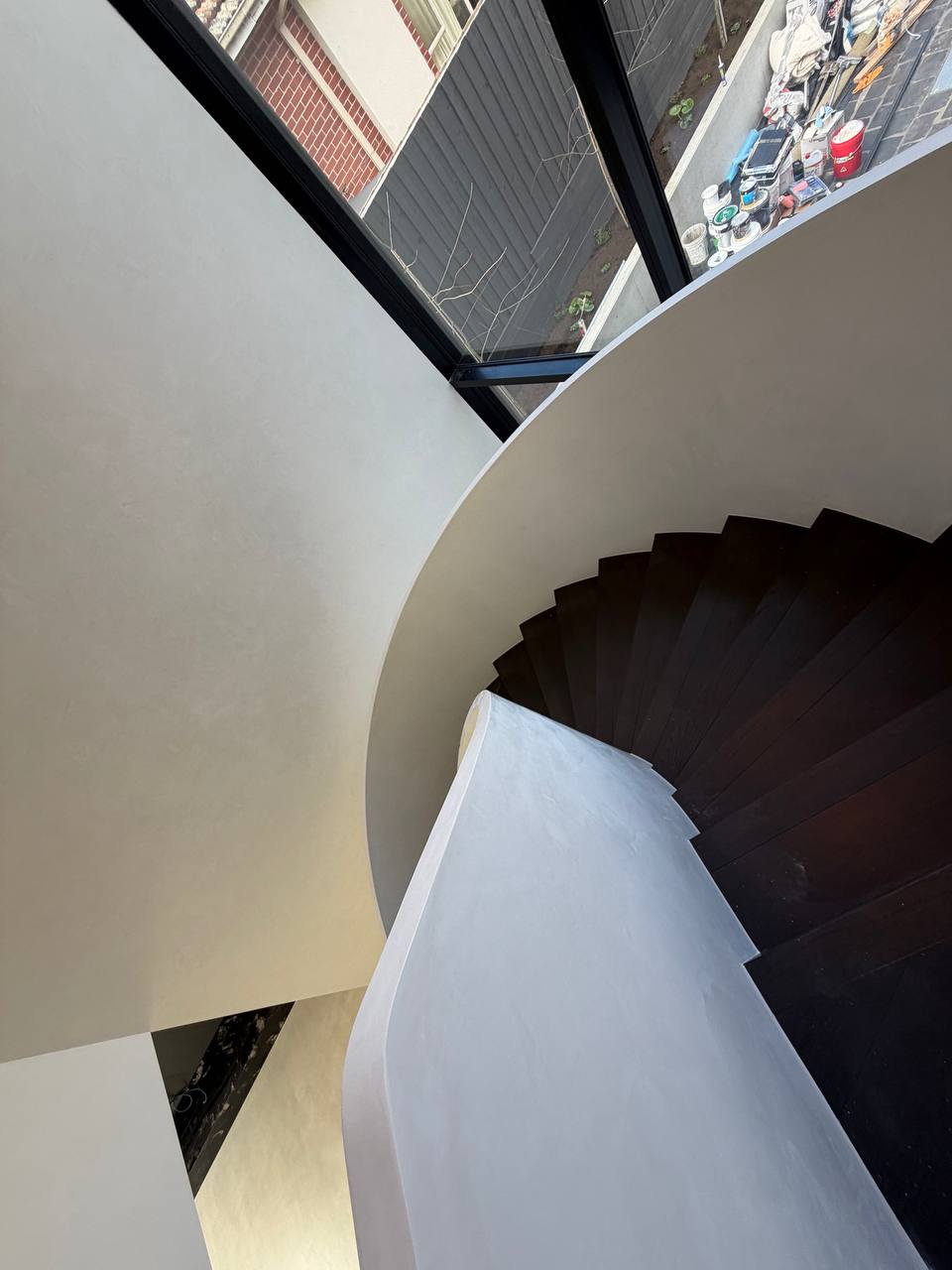
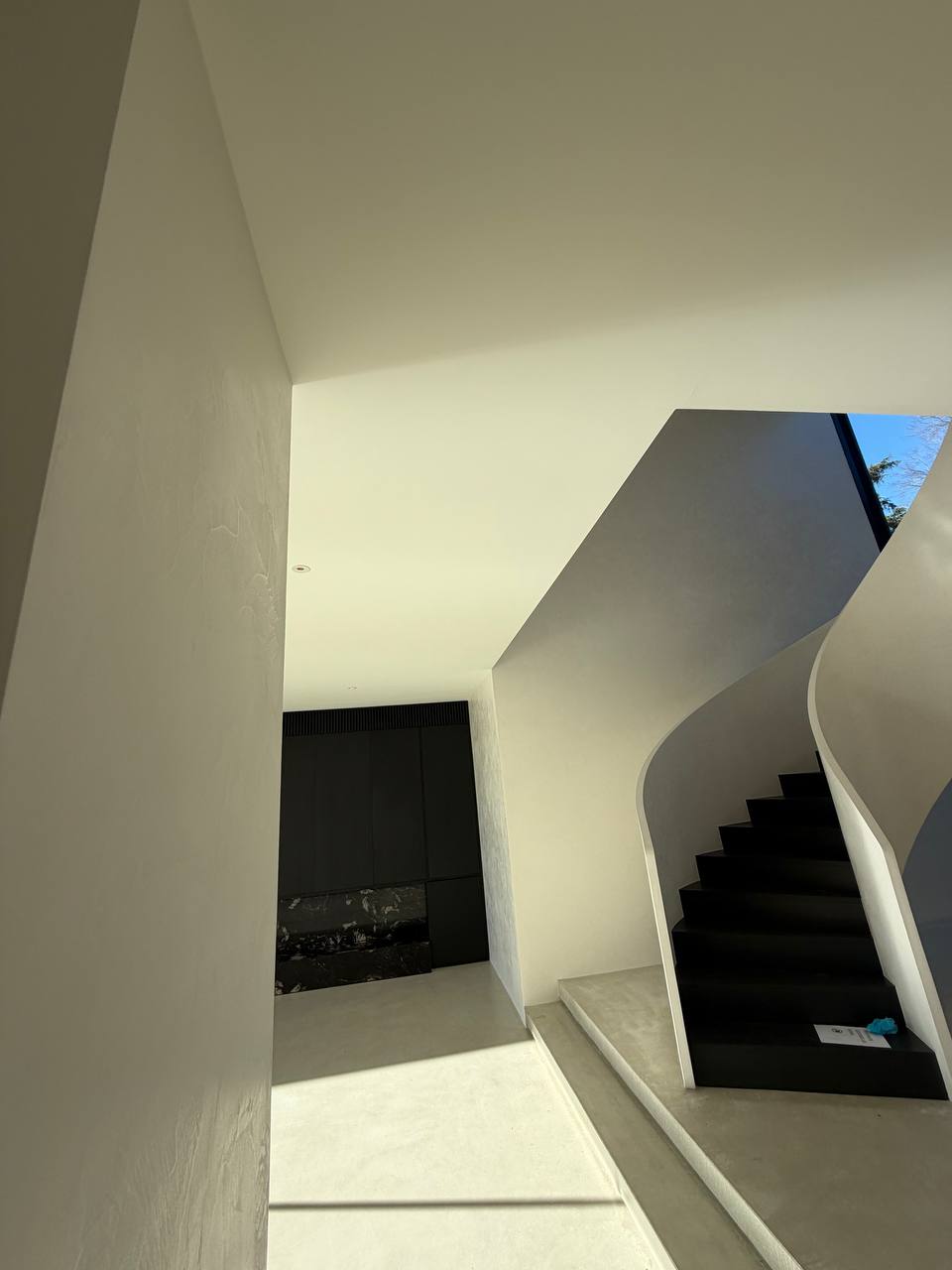
The home has a helical staircase wrapped in a curved plaster wall, and a curved wall running the length of the upstairs hallway where it meets dark timber flooring. A straight caulking run is tooled in long strokes. A curve has to be worked in short overlapping sections, each one blended into the last, because the tool angle changes continuously. Rush it and you get a visible scalloped edge that catches the light along the whole curve.
2. Venetian plaster is unforgiving
Polished render and Venetian plaster walls are porous and cannot be wiped clean the way painted plasterboard can. Silicone smeared onto the surface soaks in, and the mark does not come out. Every joint on this job was masked both sides before application, and the tape pulled while the sealant was still wet.
3. Natural stone needs neutral cure silicone, not acetic
The ensuite vanity and the kitchen island are natural stone. Standard acetic cure silicone, the kind that smells like vinegar, releases acetic acid as it cures and can etch and stain porous stone like marble. Neutral cure silicone is the correct product. This is one of the most common mistakes we are called back to fix, and by the time the staining shows the damage is in the stone, not the sealant.
4. Mitred stone edges leave nowhere to hide
Where stone is mitred, the joint between two slabs is a hairline shadow. The sealant bead has to sit inside that line, colour matched, with no overrun onto either face. On a square edge you have a few millimetres of tolerance. On a mitre you have almost none.
5. No skirting means no margin for error
Much of this home uses a shadow line detail instead of skirting boards. In a conventional house a skirting board covers the gap between wall and floor. Here the caulking bead is the finish, viewed directly, at eye level down a long hallway. Any variation in bead width reads immediately.
6. Dark cladding and glazing move more than they look
The exterior combines dark stained vertical timber cladding with full-height glazing in black frames. Dark surfaces absorb heat and move more through the day than light ones, and timber moves differently to aluminium. External joints here need an exterior grade sealant with enough movement capability to handle that, not a general purpose silicone.
7. Mixed substrates in a single run
A single joint in this home can run from stone to plaster to timber veneer to glass. Sealant adhesion differs on each, and some products will not bond to certain finishes at all. The joints were grouped by substrate pairing and the product selected for each, rather than running one tube through the whole house.
Bathroom and Wet Area Caulking
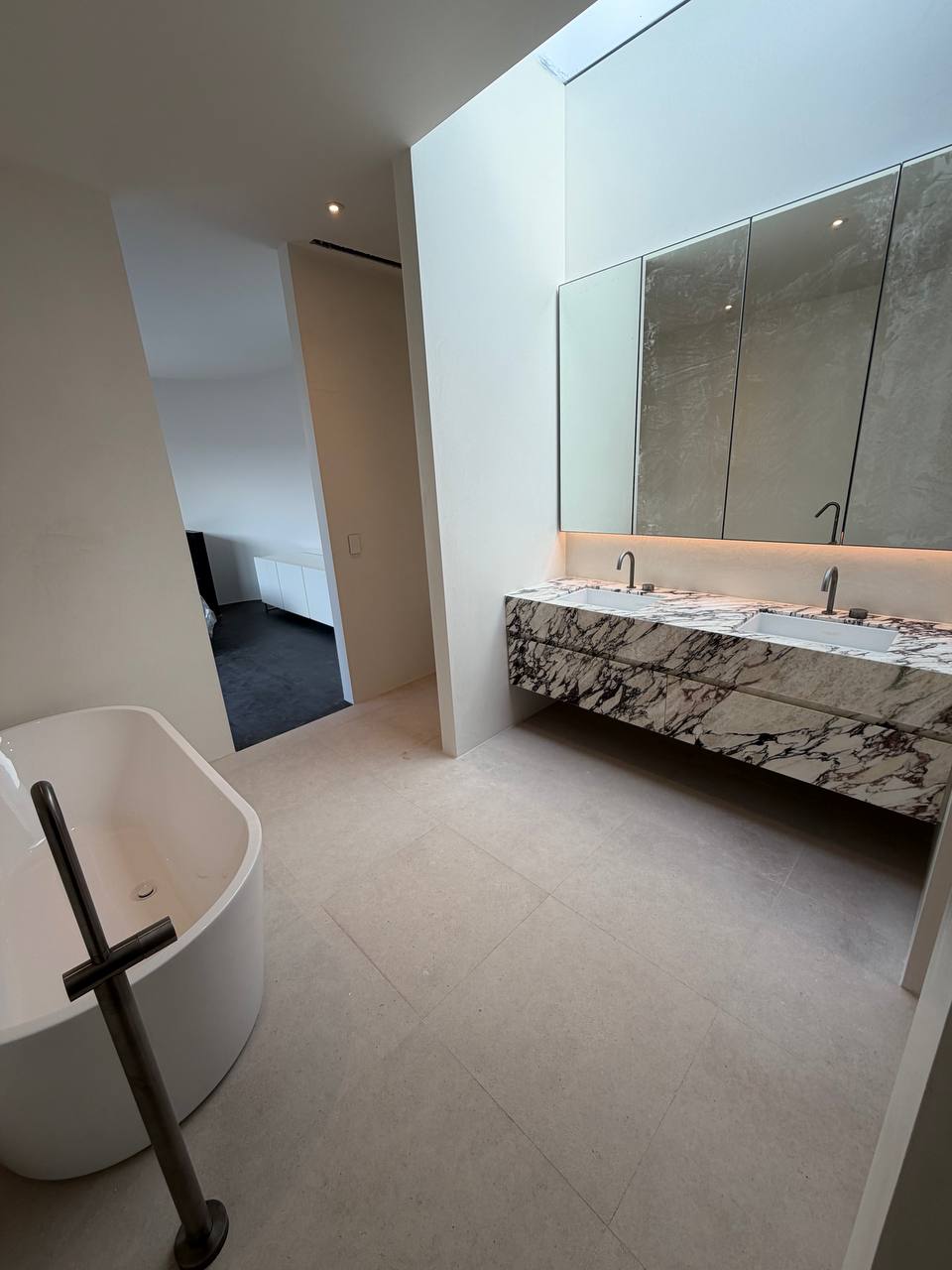
The main ensuite pairs a floating veined marble vanity with twin undermount basins, a freestanding bath on a floor-mounted spout, and a walk-in shower in large format honed tile.
The joints sealed here were:
- Undermount basin rims to the stone benchtop
- Benchtop to the wall return, where stone meets Venetian plaster
- The floating vanity’s underside shadow line
- Shower wall to floor junctions and internal corners
- Floor-mounted spout and tapware penetrations
- Perimeter of the freestanding bath where it meets the tiled floor
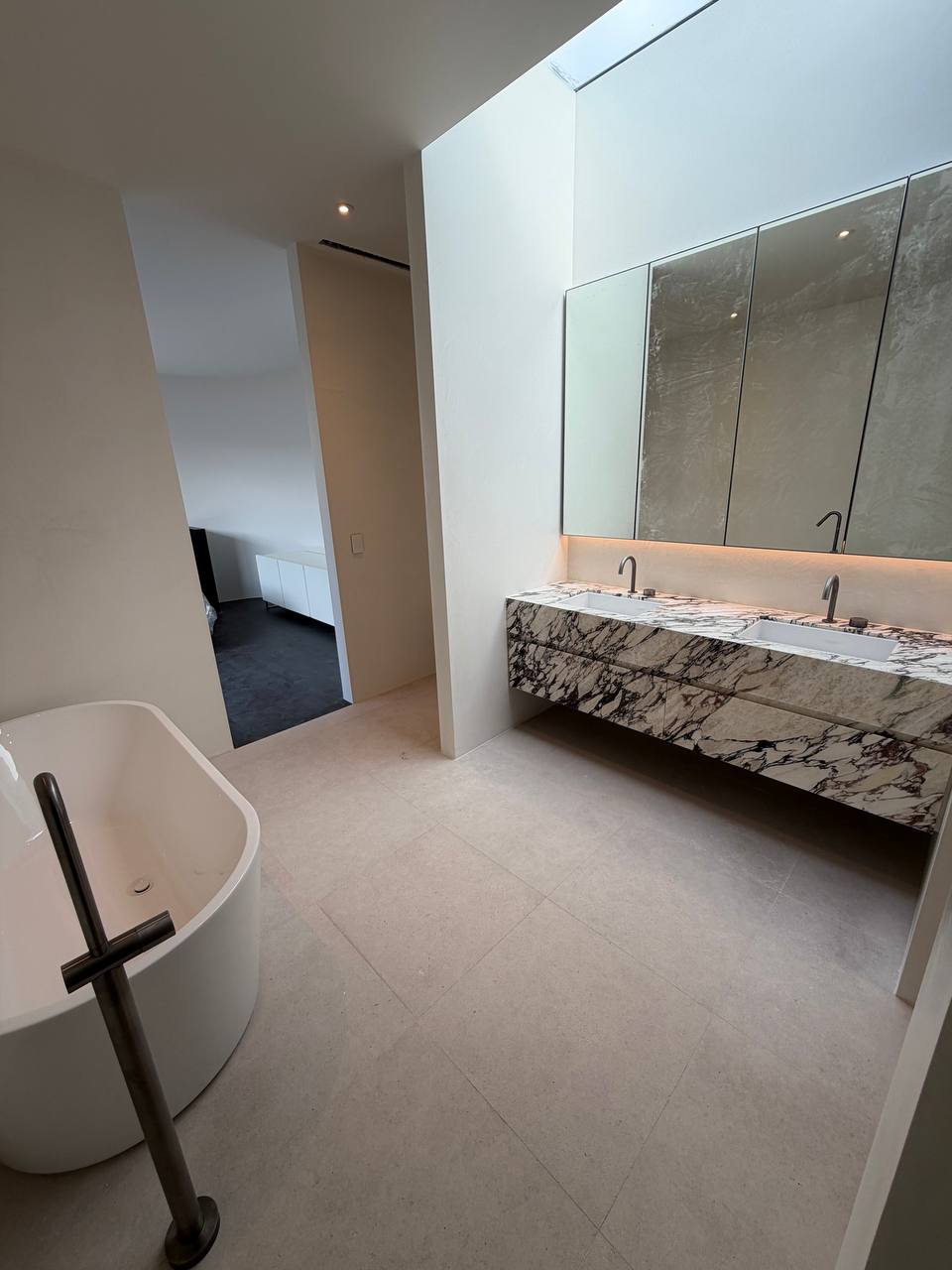
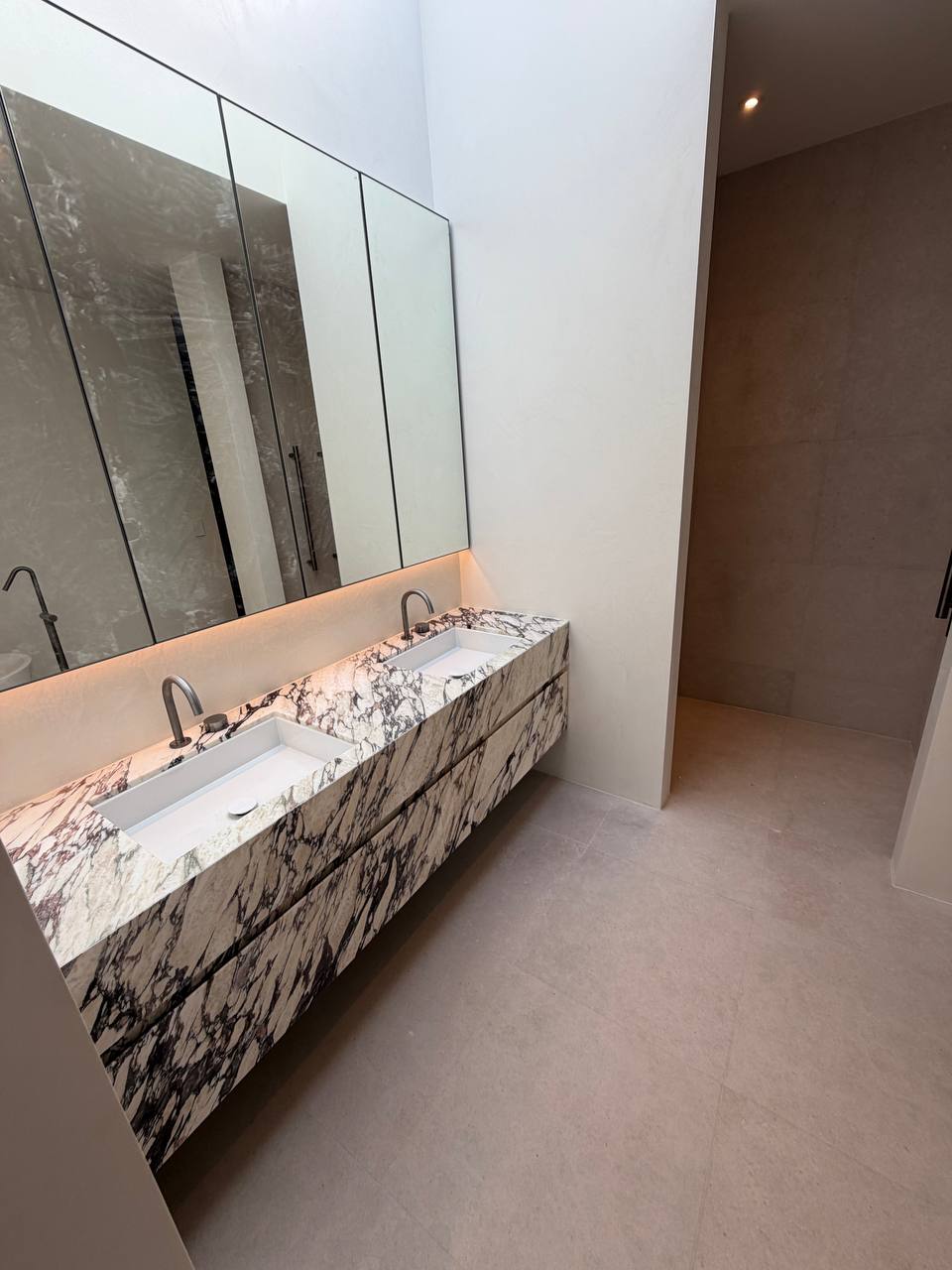
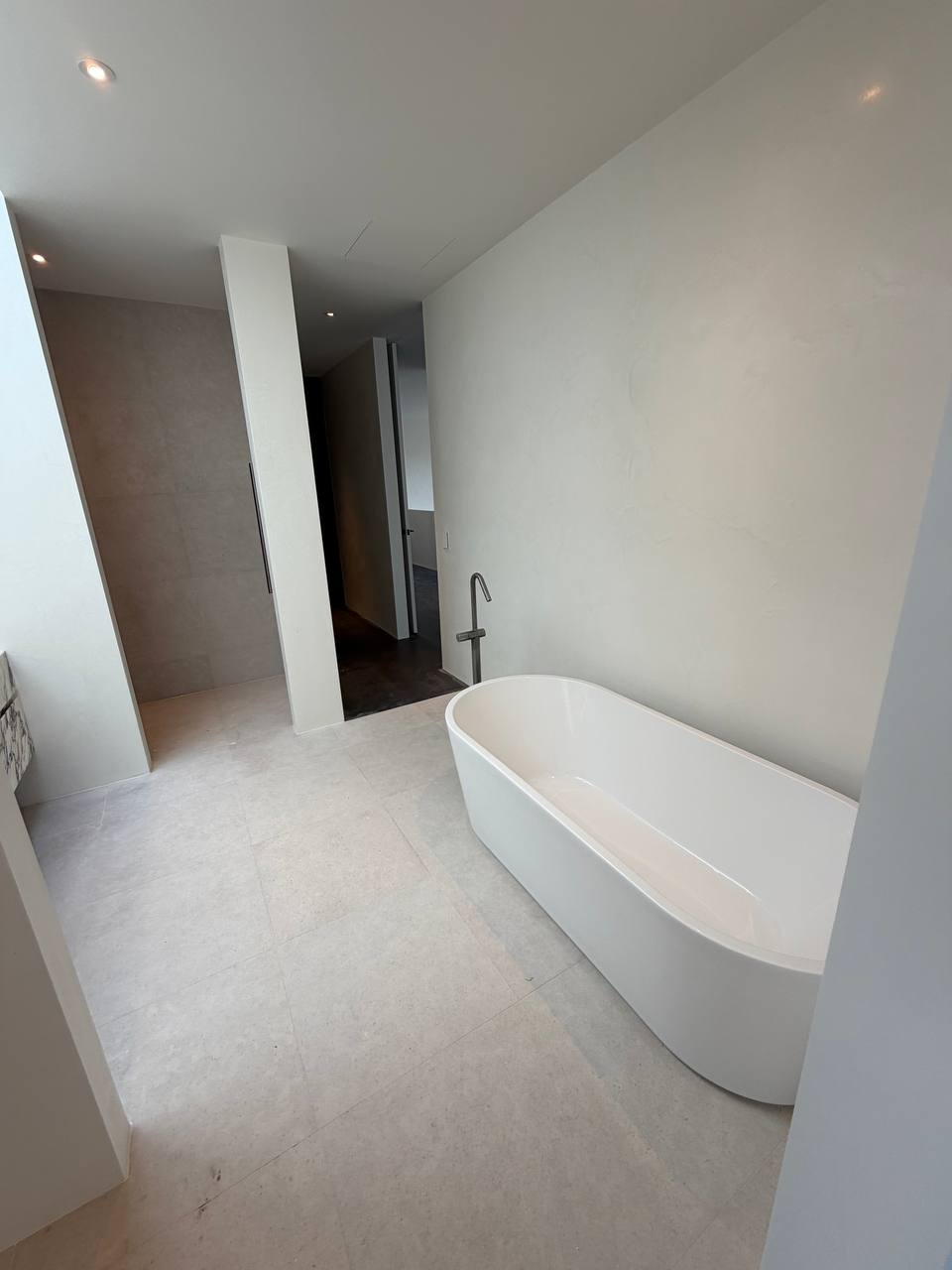
All wet area joints used a sanitary grade sealant with a mould inhibitor. Stone joints used neutral cure product for the reason in point 3 above.
One thing worth saying plainly: silicone is not waterproofing. A sealant bead keeps water out of a joint. It does not replace the waterproofing membrane under the tiles. If a bathroom is leaking, the membrane needs assessing before anyone reseals anything, and resealing over a membrane failure hides the problem rather than fixing it. We do both the caulking and the waterproofing, so we can tell you which one you actually have: our guide on whether a bathroom leak is the silicone or the waterproofing walks through the signs.
Kitchen and Joinery Caulking
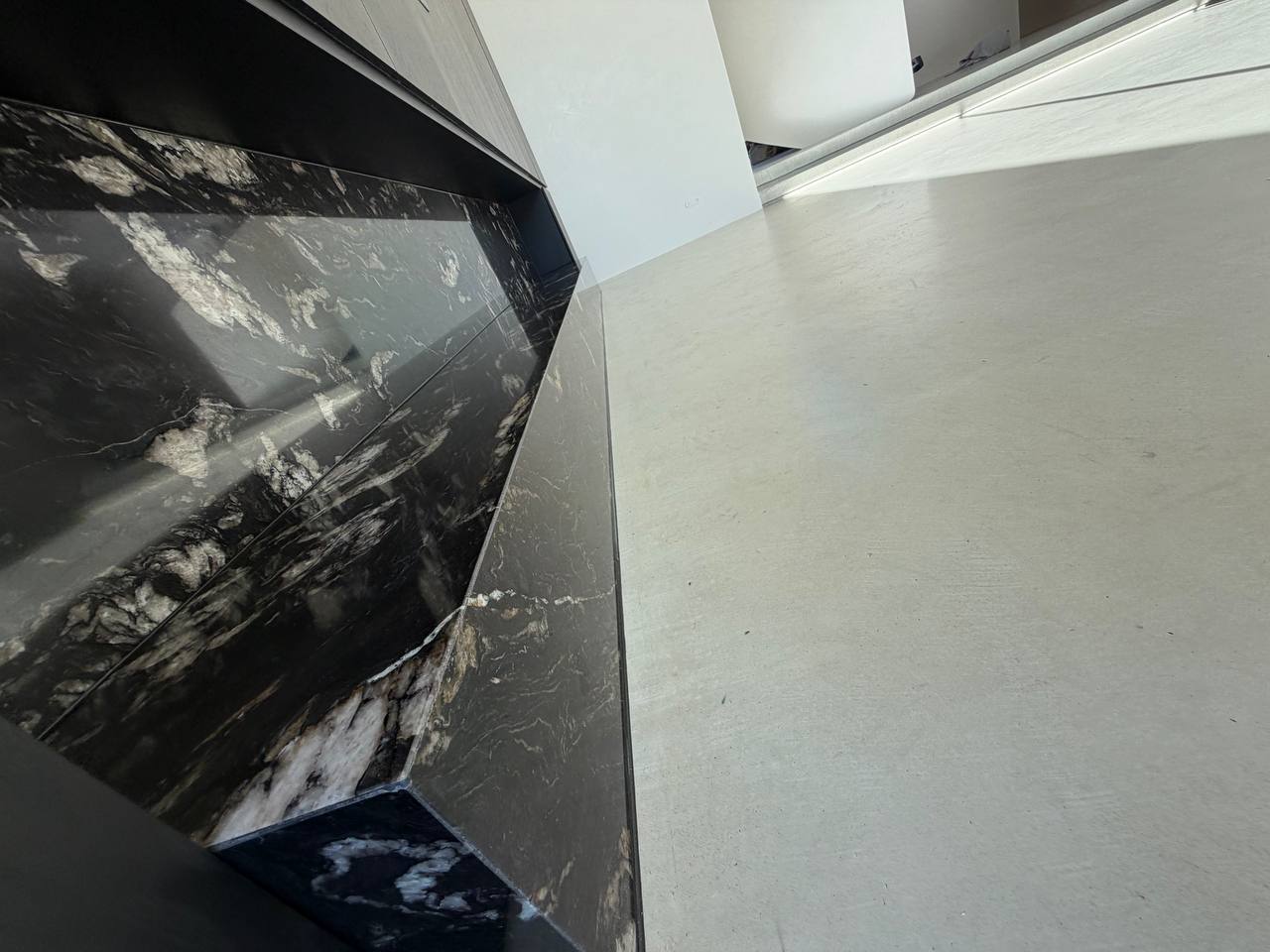
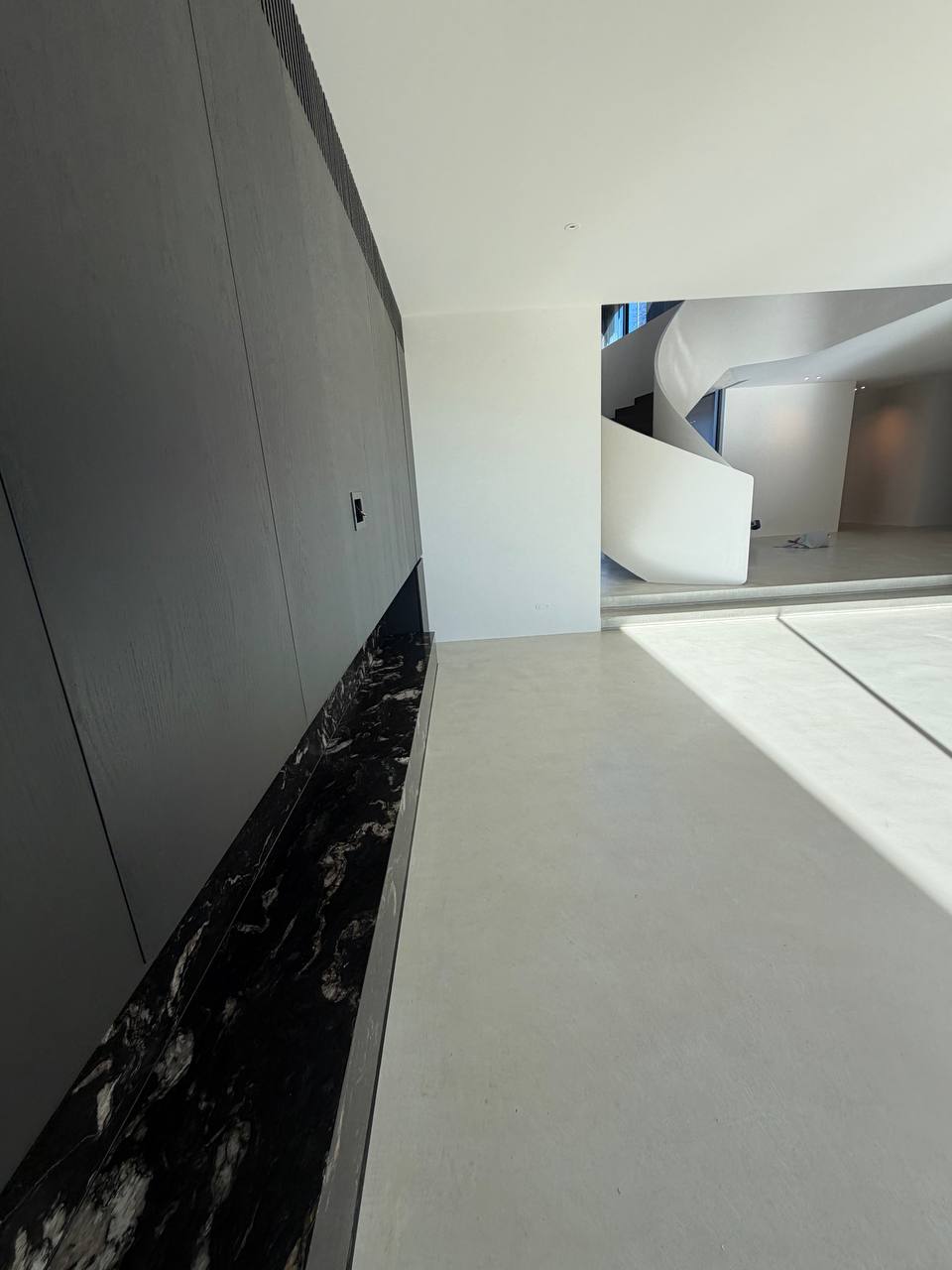
The kitchen runs a dark stone island and splashback against full-height timber veneer joinery, with the stone mitred at the corners.
Work here covered the splashback to benchtop junction, mitred stone corners, the joinery to stone interface, cabinetry to wall and floor junctions, and the toe kick line. The colour match mattered more than usual: against a near-black stone with white veining, a standard grey or translucent sealant reads as a light stripe across the join.
Floor Caulking Around Curved Walls
This was the most demanding part of the project.
The upstairs hallway has a curved plaster wall meeting dark timber flooring with no skirting. Internal floor caulking seals the perimeter expansion gap that timber flooring needs to move, and finishes the junction where two very different materials meet.
On a curve, three things change. The bead has to maintain constant width while the tool angle rotates. The colour has to hold against both a white wall and a dark floor at once. And because there is no skirting, the result is the visible finish rather than something covered later.
The same applies around the base of the helical staircase, where the curved plaster balustrade wall lands on the floor.
Window and External Caulking
The home uses full-height glazing in black powder-coated frames, including a corner glazing detail, set against dark stained vertical timber cladding and rendered sections.
Internally we sealed window frame perimeters where aluminium meets plaster and stone reveals. Externally the work covered frame to cladding junctions, cladding to render transitions and control joints.
Neutral cure sealant is required on glazing. Acetic products can corrode certain metal finishes and affect some glazing seals. On the external joints, movement capability and UV stability matter more than anything else, because these joints sit in full sun and cycle every day.
Where a building is already showing water ingress, the cause needs identifying before sealing. Caulking an active leak without finding the entry point usually just moves the water somewhere less visible.

5 Signs Your Build Needs a Specialist Caulker
Not every job needs one. These five do.
- There is natural stone anywhere in the build. Marble, travertine and limestone are porous and can be permanently stained by the wrong sealant.
- The walls are Venetian plaster, polished render or microcement. These cannot be cleaned up after a mistake.
- There are curved walls, or shadow line details instead of skirting. The bead is the finish, not something that gets covered.
- The joinery is mitred, or the stone is dark with strong veining. Colour matching and tolerance both get harder.
- The facade mixes materials. Timber and aluminium and render all move at different rates, and the joints between them carry that movement.
If none of these apply, a competent general trade will usually do fine. If two or more apply, the cost of getting it wrong is the finish itself, and remediation on stone or plaster is far more expensive than the caulking was.
Our Quick Roundup: Where the Risk Actually Sits
| Area | Risk if done badly | Difficulty |
|---|---|---|
| Wet areas | Water damage, mould, callbacks | Moderate |
| Natural stone joints | Permanent staining or etching of the stone | High |
| Curved floor perimeters | Visible wavy bead, no way to hide it | High |
| Venetian plaster junctions | Permanent smearing on a costly finish | High |
| Mitred stone edges | Overrun onto the face, colour mismatch | High |
| External cladding joints | Joint failure, water ingress, UV breakdown | Moderate to high |
| Standard square rooms | Cosmetic only | Low |
The pattern is consistent. On architectural builds the expensive failures are not leaks. They are permanent marks on finishes that cost more than the caulking contract.
Balwyn North Caulking FAQs
How long does a complete house caulking job take?
It depends on the number of joints rather than the floor area. A full house on a standard build is often one to two days. An architectural home with curved walls, mitred stone and extensive glazing takes longer, because the preparation and masking take as much time as the application.
Can you caulk natural stone like marble?
Yes, with the correct product. Neutral cure silicone is used on natural stone because acetic cure silicone can etch and stain porous surfaces. Confirm this with any contractor before they start, because the damage is not reversible.
Do you work with builders during construction?
Yes. On new builds we are usually on site at the finishing stage, after joinery and stone are installed and before handover. Builders, renovators and private clients all book the same service.
Is caulking the same as waterproofing?
No. Caulking seals a joint between two surfaces. Waterproofing is a membrane system installed under tiles before they are laid. Silicone does not replace a membrane, and resealing will not fix a membrane failure.
Do you service Balwyn North and the surrounding eastern suburbs?
Yes. We work across Balwyn North, Balwyn, Camberwell, Canterbury, Box Hill, Burwood, Glen Iris, Hawthorn and the surrounding areas, as well as the rest of Melbourne. See our service areas.
What does caulking cost?
Pricing depends on the number and type of joints. Bathroom resealing starts from $250 for a single shower. Complete house projects are quoted after a site assessment, because substrate and joint count drive the price more than house size.
Get a Quote for Your Balwyn North Project
If you are building, renovating or finishing a home in Balwyn North or Melbourne’s eastern suburbs and the detailing matters, we can assess the joints and recommend the right approach for each surface.
Professional Caulking Group has been caulking Melbourne homes for over seven years, with more than 570 five star Google reviews.
Call 0435 803 646 or request a quote online.