

The hardest part of townhouse caulking across four identical units is not any single joint. It is making all four look like the same hand did them.
Professional Caulking Group recently completed the caulking across a four-townhouse development in Carlton, covering every bathroom, kitchen, wet area, window and external joint in all four dwellings as a single job.
A buyer inspecting unit three has usually just walked through unit one. If the bead around the shower screen is a different width, or the line at the splashback sits slightly higher in one kitchen than the next, they see it immediately, even if they could not name what is bothering them. On a single home nobody has a reference to compare against. On a development, every unit is the control for the others.
This post covers what a four-unit job actually involves, the 6 things that make repetition harder than complexity, and what builders should check before handover.
Quick answer: Caulking a multi-unit development means sealing every bathroom, kitchen, laundry, window and external joint across all dwellings to one consistent standard, as a single job rather than unit by unit. The difficulty is volume and repeatability rather than technical difficulty: the same joints recur dozens of times and all of them have to match, because buyers and the builder compare units directly. Pricing is quoted on total linear metres and joint count across the development, not per dwelling.
Project at a Glance
| Detail | This project |
|---|---|
| Suburb | Carlton, Melbourne |
| Property type | Four attached two-storey townhouses, new build |
| Dwellings | 4, identical specification |
| Areas sealed | Bathrooms and ensuites, kitchens, wet areas, internal floor junctions, window perimeters, external cladding and control joints |
| Key substrates | Large format porcelain tile, engineered stone, timber veneer joinery, frameless glass, powder-coated aluminium, fibre cement cladding, brick |
| Sealant types | Sanitary grade for wet areas, neutral cure for stone and glazing, exterior grade for cladding and control joints |
| Client type | Builder, pre-handover |
This is a different kind of job from the architectural new build in Balwyn North we finished recently. That house was one-off details and curved walls. This one was consistency at volume.
Multi-dwelling infill is increasingly common across Carlton and Melbourne’s inner north, where a single site delivers several homes at once rather than one. That changes what the finishing trades are being asked to do, caulking included.
6 Reasons Four Identical Units Are Harder Than One Custom Home
It sounds backwards. Four of the same thing should be easier than one complicated thing. In practice the opposite is true, for six reasons.
1. Every unit is a reference for the others
On a one-off house, a bead that is a millimetre wider than the one in the next room goes unnoticed, because nobody is holding them side by side. On a development, buyers, the builder and the building surveyor all walk through multiple units in sequence. Variation that would be invisible in isolation becomes obvious in comparison.
2. The same mistake is repeated four times
Get a detail wrong on a single home and it is one rectification. Get it wrong on a four-unit site and you are back for four, in four separate dwellings, often after the floors are protected and the appliances are in. The cost of an error multiplies in a way it simply does not on a one-off.
3. Large format tile means long uninterrupted runs
These bathrooms use large format porcelain. Fewer grout lines looks cleaner, but it also means a single silicone run can travel two metres or more without a break. There is nowhere for a join or a hesitation to hide, and any waver reads along the full length.
4. Frameless glass has no tolerance
Frameless shower screens sit directly against tile with a bead doing the sealing and nothing covering it. The joint is visible from both sides, it is wet constantly, and it is the single most common callback in new bathrooms. Across four units that is eight or more screens to get identical.
5. The kitchens repeat too
Stone benchtop to full-height stone splashback, around the cooktop cutout, benchtop to wall return, cabinetry to floor. One kitchen is routine. Four kitchens finished to an identical line, with the same sealant colour against the same stone, is a discipline problem rather than a skill problem.
6. Handover is a single date
Four dwellings usually settle together. There is no sequencing the work unit by unit over months. Everything has to be complete, cured and defect free for one inspection, which means the job has to be planned around the site programme rather than around the caulking.
None of this is difficult in the way a curved plaster wall is difficult. It is difficult in the way that doing the same thing well two hundred times in a row is difficult.
Bathrooms and Ensuites Across the Four Carlton Units
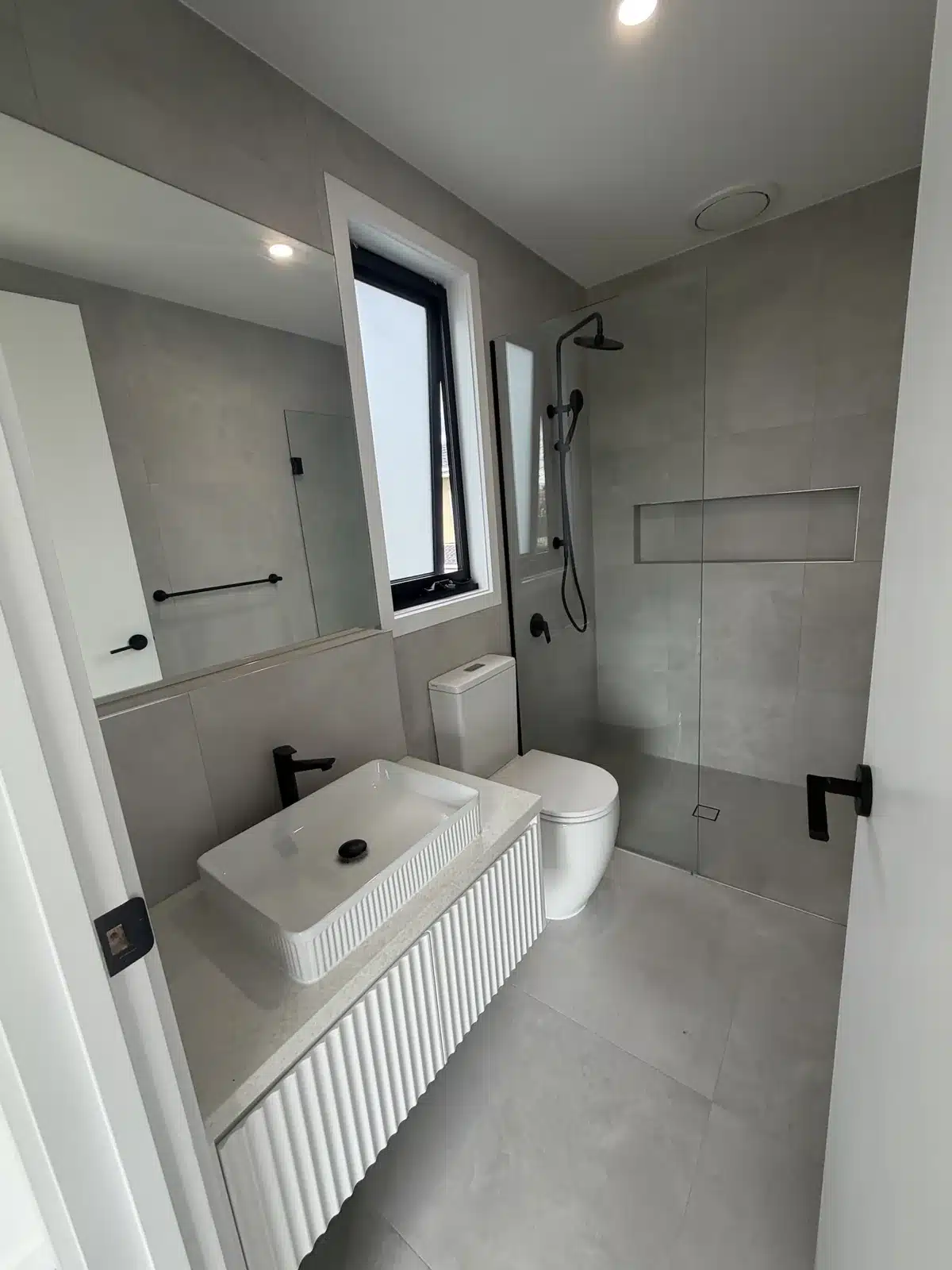
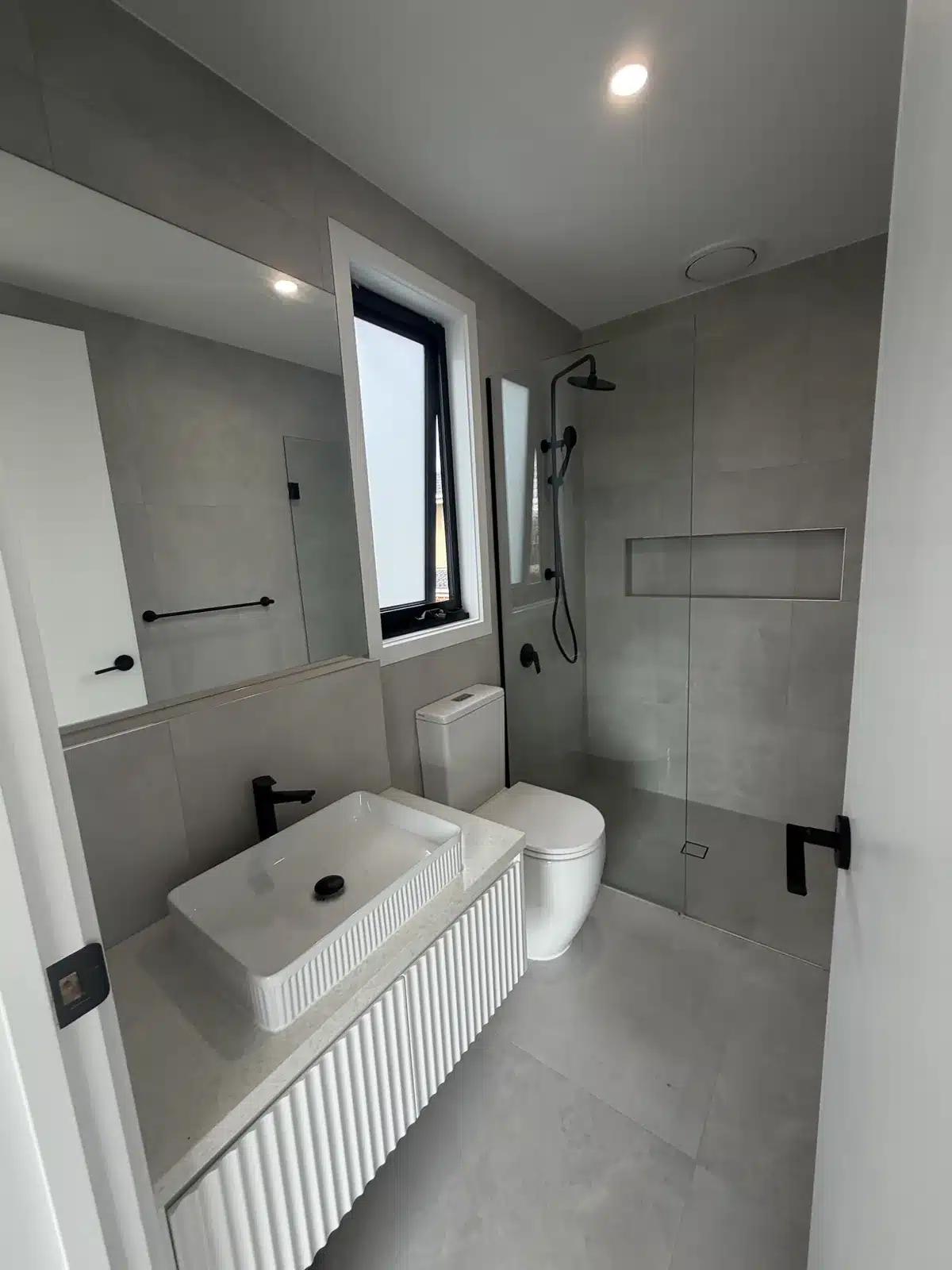
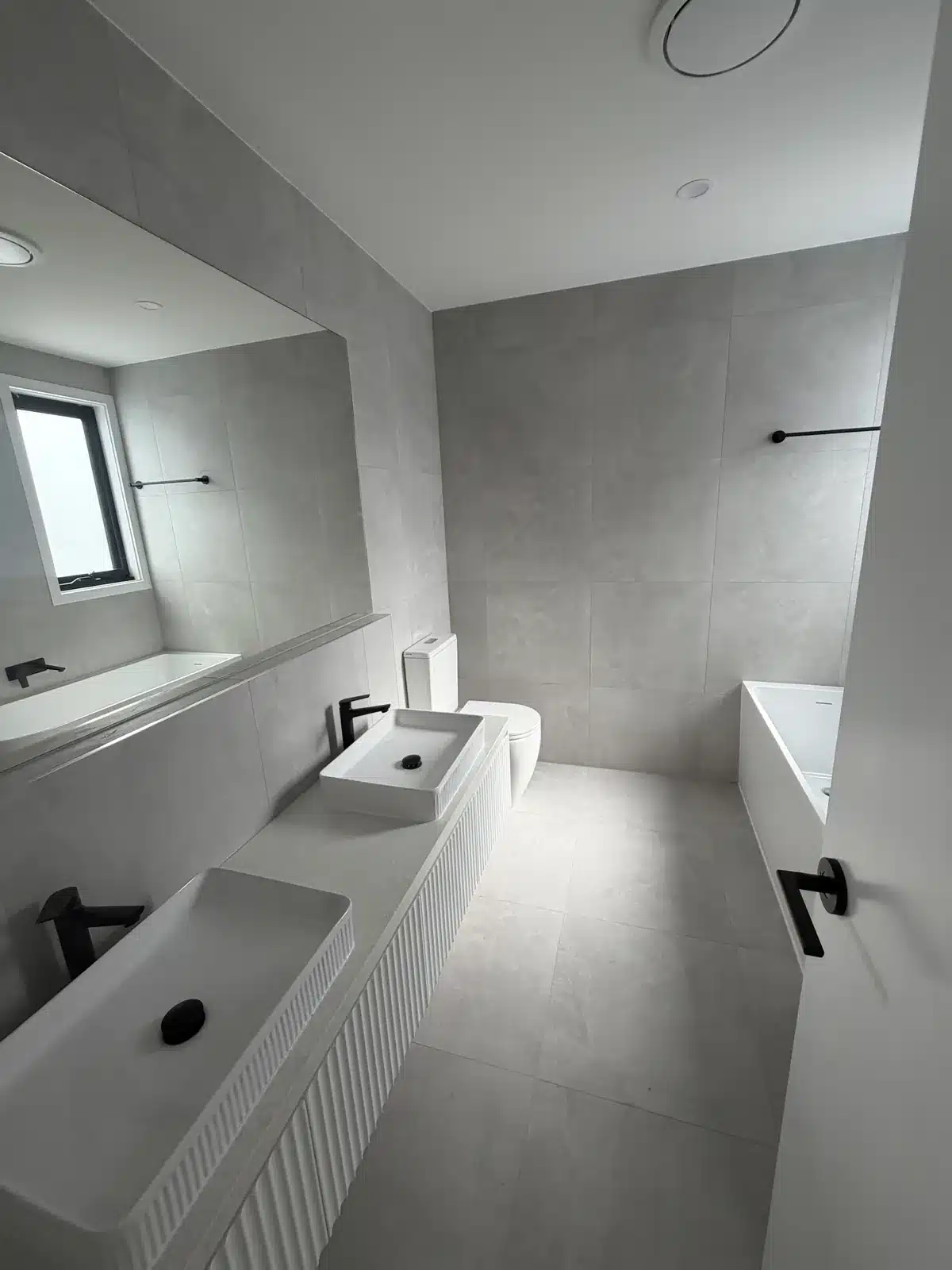
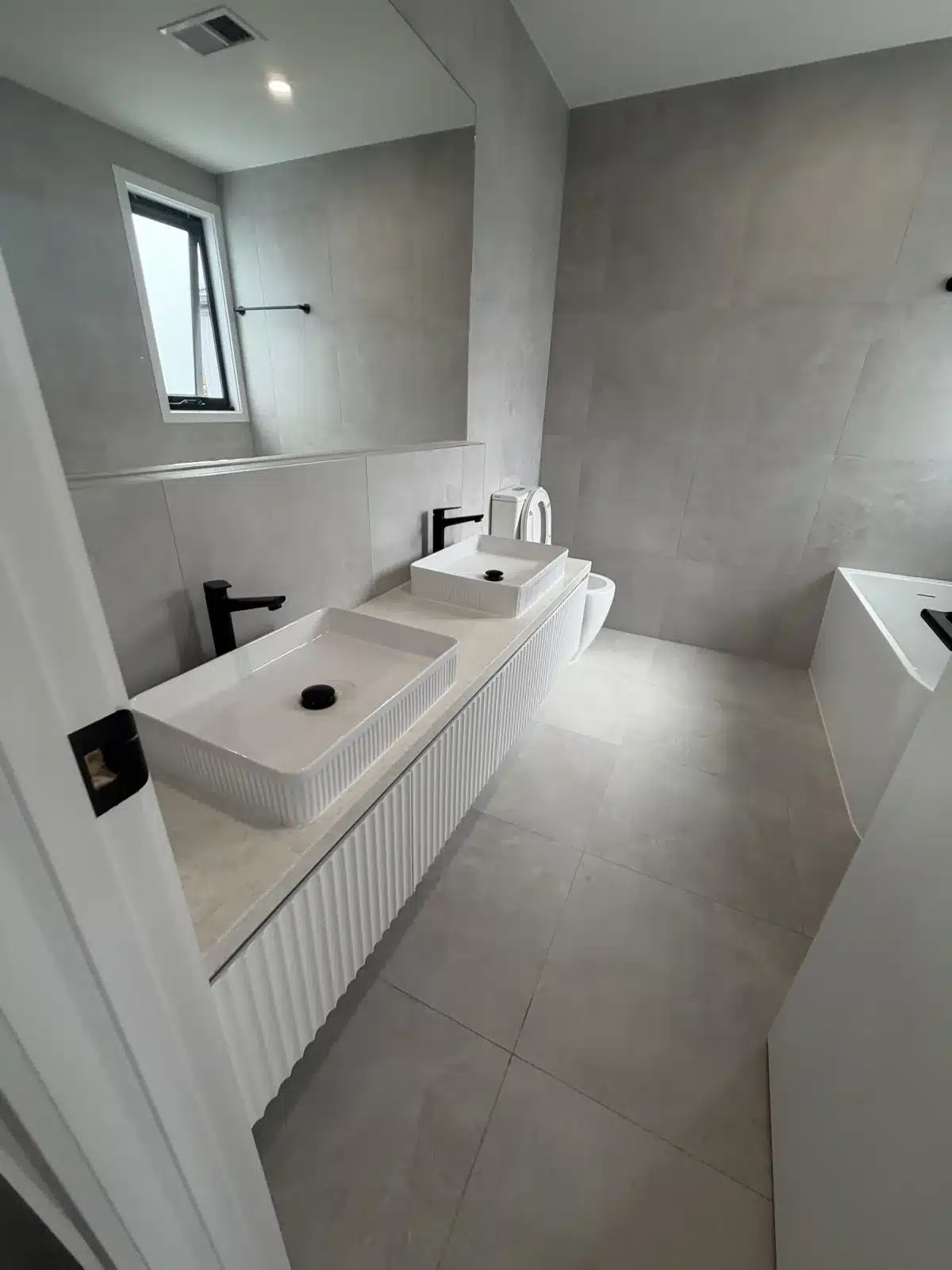
The bathrooms across the four units share one specification: large format grey porcelain to the walls and floor, wall-hung fluted vanities with vessel basins, matte black tapware, mirror returning to the benchtop, and either a back-to-wall bath or a walk-in shower with a frameless screen and a tiled niche.
The joints sealed in each:
- Shower wall to floor junctions and all internal corners
- Frameless screen to tile, both the vertical and the base
- The tiled niche perimeter, which is a common leak point and routinely rushed
- Around the bath where it meets tile and the wall return
- Vessel basin to benchtop, and benchtop to the fluted vanity carcass
- Benchtop to wall, and the underside of the mirror where it lands on the benchtop
- Tapware and floor waste penetrations
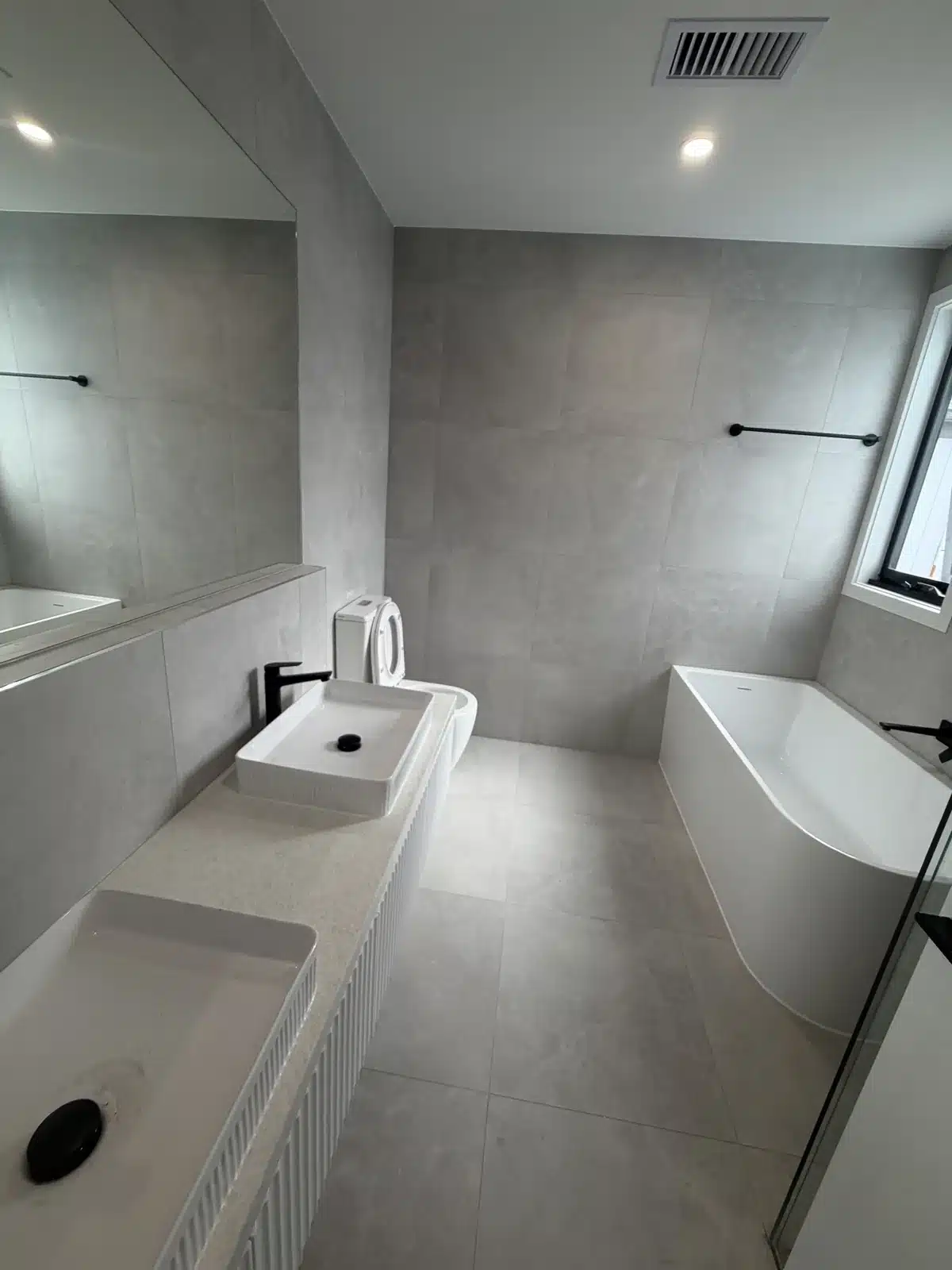
All wet area joints used a sanitary grade sealant with a mould inhibitor.
One detail worth calling out. Vessel basins sitting proud on a benchtop seal differently from undermount basins. The bead runs around the outside of the basin where it is seen directly and touched constantly, so it has to be neat and it has to be the same on all eight or so basins across the development.
And the standard caveat, which matters more on a new build than anywhere: silicone is not waterproofing. The membrane goes in under the tiles before they are laid. Caulking seals the joints on top of it. Neither substitutes for the other. We handle both, so if a leak does appear we can tell you whether it is the silicone or the waterproofing rather than guessing.
Kitchens in All Four Carlton Townhouses
Each kitchen runs a stone benchtop with a full-height matching stone splashback, handleless white base cabinetry, oak veneer overheads and timber flooring.
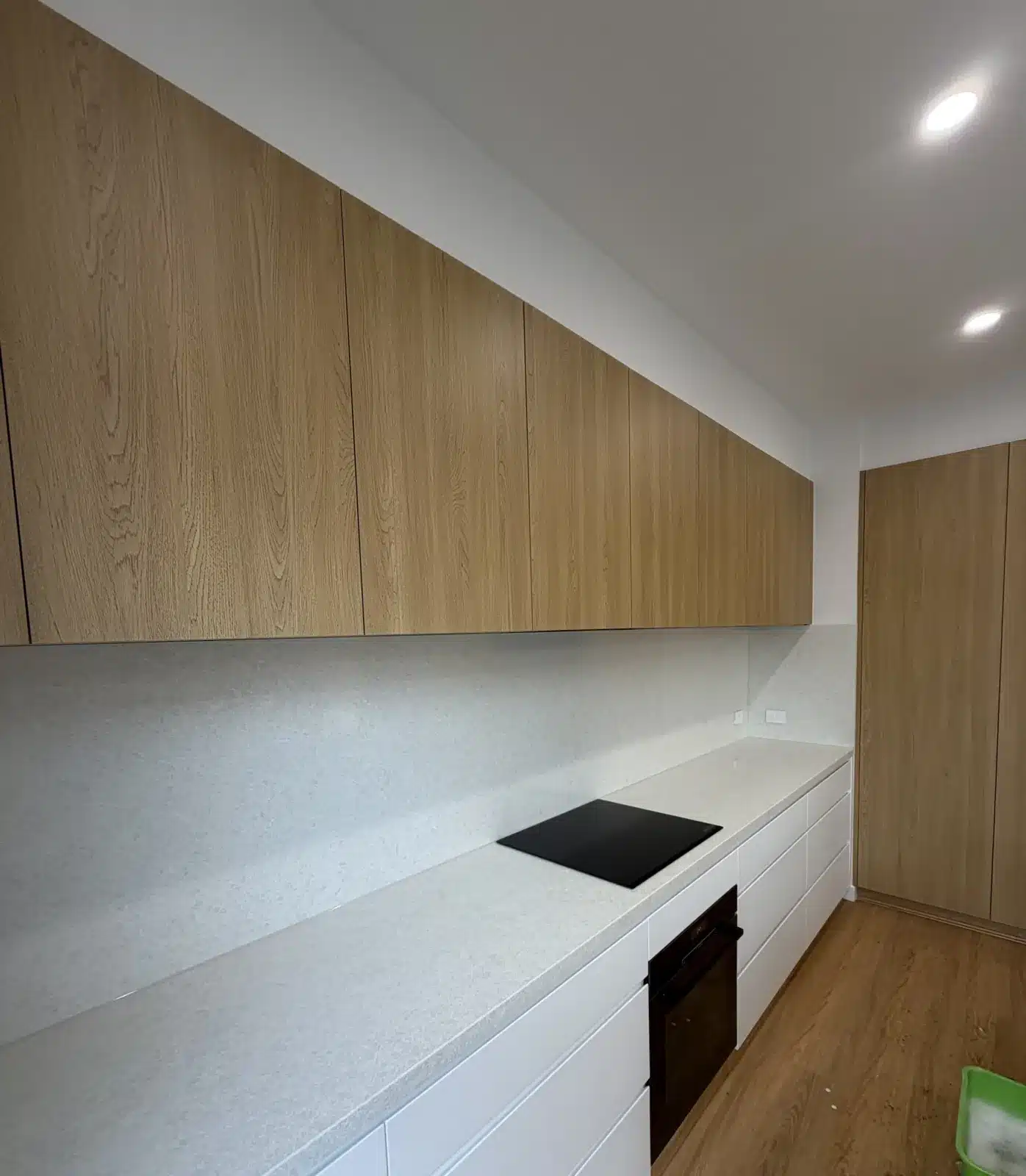
The sealing covered the benchtop to splashback junction, the splashback to overhead cabinet line, around the cooktop and sink cutouts, benchtop to wall returns, and the cabinetry to floor junction.
The benchtop to splashback joint is the one that matters most and the one most often done badly. It is at eye level, it is lit by the under-cabinet lighting, and it runs the full length of the kitchen. Across four identical kitchens it needs the same sealant colour against the same stone and the same bead profile, or the units stop looking like they came from one builder.
Windows and the External Envelope
Externally the buildings combine white vertical cladding, red brick piers and black powder-coated window frames.
That combination is three materials with three different rates of thermal movement meeting at the same joints. Fibre cement, masonry and aluminium do not expand and contract together, so the joints between them need an exterior grade sealant with real movement capability rather than a general purpose silicone.
The external work covered window and door frame perimeters, cladding to brick transitions, cladding sheet joints and the control joints between dwellings. On attached townhouses those control joints are structural in purpose: they let each dwelling move independently. Sealing them correctly is not cosmetic.
Internally, window reveals were sealed where the frame meets plaster and tile.
Where a building shows water ingress, the cause needs identifying before anything is sealed. Caulking over an active leak usually just relocates the water.
6 Caulking Defects to Check Before Multi-Unit Handover
If you are a builder signing off several dwellings at once, these are the items that come back as defects most often. All six are quicker to fix before the floor protection comes up.
- Bead width that varies between units. Walk unit one and unit four back to back, looking at the same joint in each. If you can see a difference, so can a buyer.
- Frameless screen bases. Check along the bottom of every screen, inside and out. This is the most common callback in a new bathroom.
- Shower niches. Check all four internal corners and the underside of the shelf. Routinely missed because they are awkward to reach.
- Cooktop and sink cutouts. Often sealed before the appliance goes in, then disturbed during installation and never redone.
- Control joints between dwellings. These are structural, not decorative. Check they are sealed continuously and not bridged with the wrong product.
- Wrong sealant on stone. Acetic cure silicone can etch and stain stone. On a stone benchtop or splashback, neutral cure is correct, and the damage from getting it wrong is in the stone rather than the sealant.
Our new home handover checklist covers the wider walkthrough.
Our Quick Roundup: Single Home vs Multi-Unit
| One custom home | Four unit development | |
|---|---|---|
| Main difficulty | One-off details, tricky substrates | Volume and consistency |
| What a mistake costs | One rectification | Up to four, in four dwellings |
| Who notices | The owner | Buyers, builder and surveyor, by comparison |
| Scheduling | Flexible | Tied to a single handover date |
| How it is quoted | Per joint and substrate | Total linear metres across the site |
| Biggest callback risk | Stone staining from wrong product | Frameless screen bases |
Carlton Townhouse Caulking FAQs
Do you quote multi-unit developments per dwelling or as one job?
As one job, priced on the total joint count and linear metres across the site. That is usually better value than four separate bookings, and it is the only way to guarantee the units match.
How long does a four-townhouse development take?
It depends on the number of wet areas per dwelling and whether external work is included. A development of this size is typically several days rather than one.
When should caulking be scheduled on a new build?
After joinery, stone, tiling, glazing and flooring are complete, and before final clean and handover. Too early and other trades disturb the work. Too late and the cure time collides with the handover date.
Do you work directly with builders and developers?
Yes. Most multi-unit work comes to us through builders at the finishing stage, and we work to the site programme.
Can you match an existing standard across later stages?
Yes. If a development is being delivered in stages, we keep the same products and bead profile so later stages match what is already built.
What about resealing later?
Silicone in a wet area has a service life, usually around ten years. Our shower resealing cost guide covers what that costs when the time comes.
Talk to Us About Your Development
If you are building townhouses, apartments or a multi-dwelling site in Carlton or anywhere across Melbourne, we can quote the caulking as one job and deliver it to one standard across every dwelling.
Professional Caulking Group has been caulking Melbourne homes for over seven years, with more than 570 five star Google reviews.
Call 0435 803 646 or request a quote online.